
If you’ve ever stepped on a vibration plate and felt that rapid shaking through your legs, you’ve probably thought:
“Is this actually good for my knees?”
It’s a fair question. Any repetitive mechanical stimulus—especially one that moves dozens of times per second—can sound like it might be hard on joints. Vibration can aggravate joints… But when used properly, it does not automatically damage them.
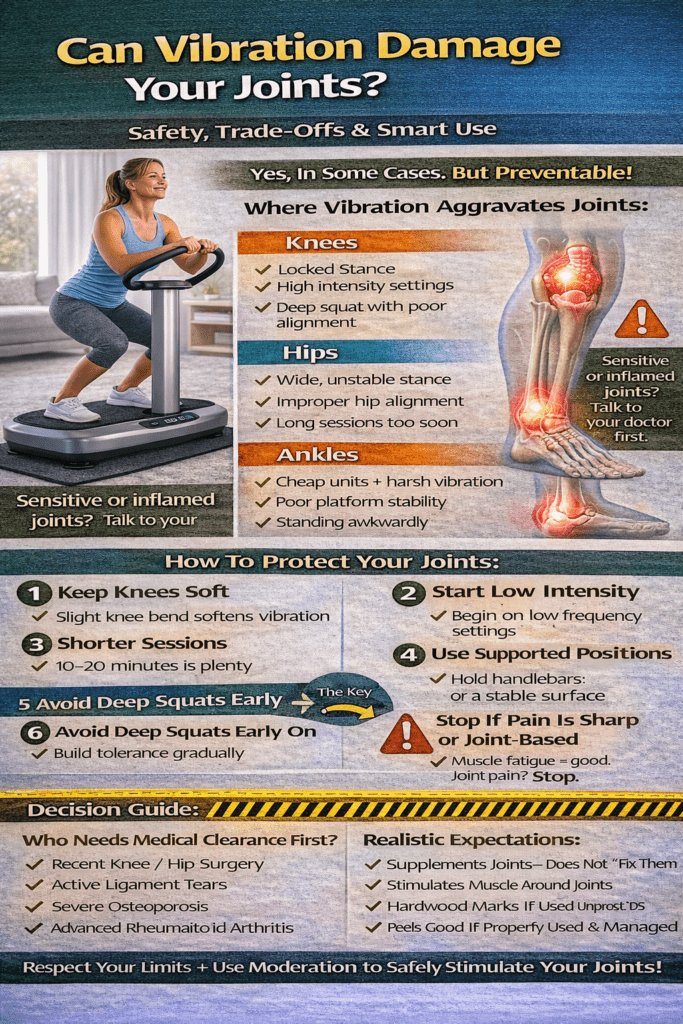
The difference comes down to:
- Intensity
- Posture
- Existing joint health
- Duration
- Equipment quality
Let’s walk through this realistically.
First: What Happens to Your Joints on a Vibration Plate?
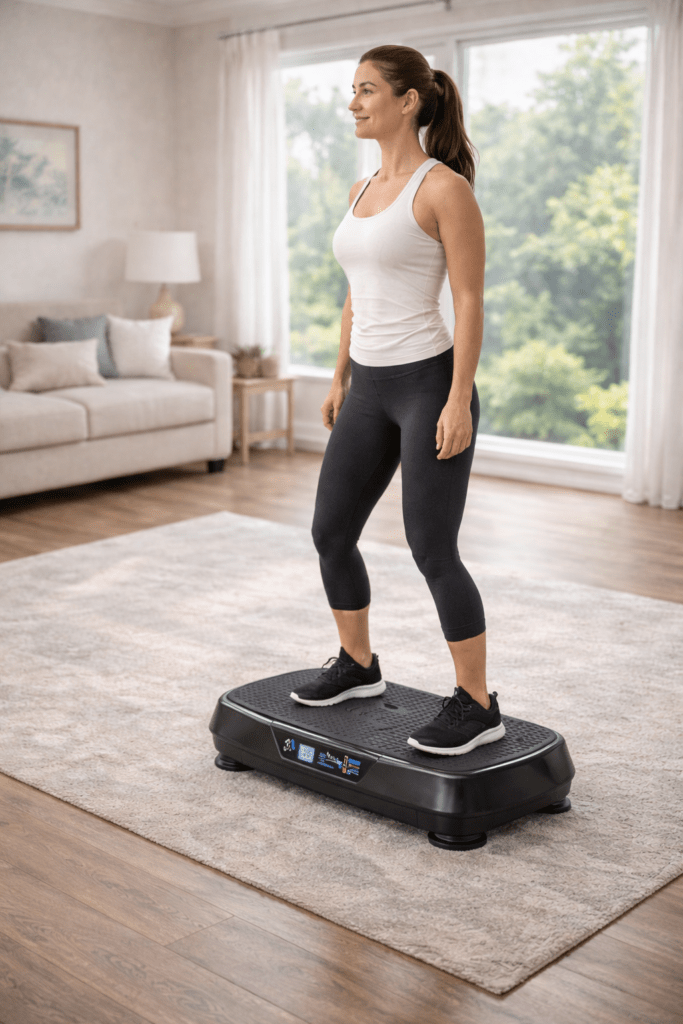
When you stand on a vibration plate, the platform oscillates. That oscillation triggers reflexive muscle contractions in your lower body.
The key detail is this: Your muscles absorb most of the vibration, not your bones and joints—if you’re positioned correctly. That “if” matters.
I’ve seen two types of users:
- People who soften their knees, engage their core, and use moderate settings.
- People who lock their knees, stand rigid, crank the intensity, and try to “feel it everywhere.”
Guess who reports joint discomfort? Almost always the second group. Vibration plates amplify what your body is doing. If your posture is poor, the machine magnifies it.
Can Vibration Cause Joint Damage?
There’s no strong evidence that appropriate home vibration plate use causes joint degeneration in healthy individuals.
However, vibration can aggravate symptoms in people with:
- Active arthritis flare-ups
- Severe joint instability
- Acute inflammation
- Recent joint surgery
- Advanced cartilage degeneration
That’s not the same as causing damage—but it can increase discomfort if misused.
If you’re concerned about safety more broadly, review:
https://www.vibrationforhealth.com/vibration-plate-side-effects/
Where Joint Pain Usually Comes From
Let’s break it down by area.
Knees
Most knee discomfort comes from:
- Locked knees
- High intensity settings
- Deep squats without proper alignment
Soft knees reduce vertical force transmission.
Hips
If your hips feel irritated, it’s often due to:
- Wide stance with unstable positioning
- Poor pelvic alignment
- Excessive session length
Ankles
Lower-cost plates sometimes feel harsher, which can irritate ankles if stability is poor.
Better-built units typically distribute motion more smoothly:
https://www.vibrationforhealth.com/
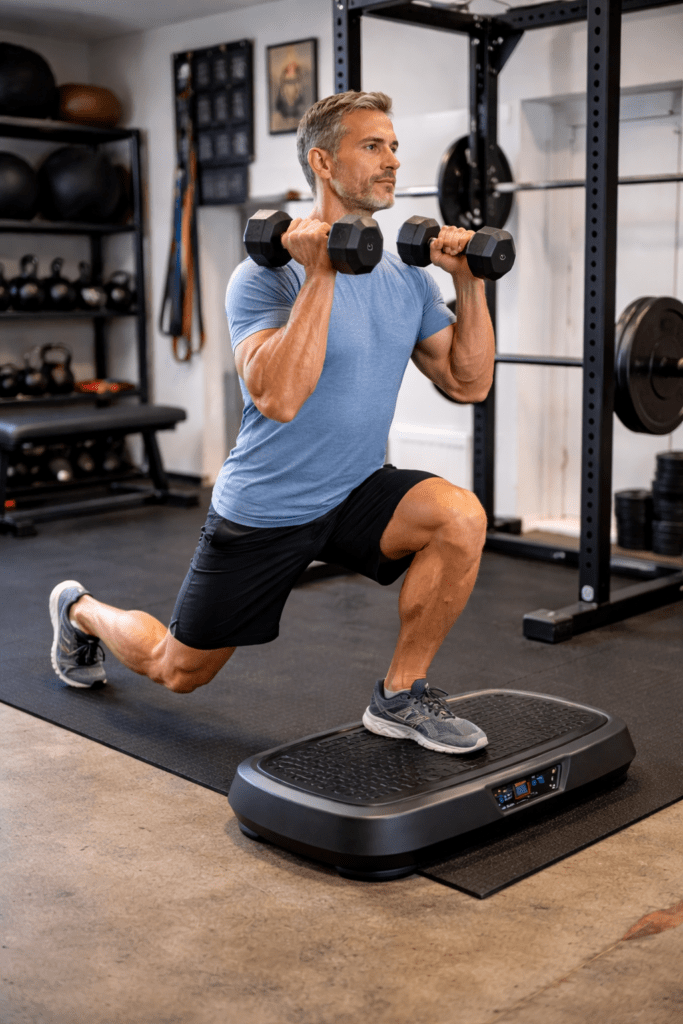
Trade-Offs: Stimulus vs Stress
Vibration plates create mechanical stimulus.
Mechanical stimulus:
- Can strengthen stabilizers
- May improve balance
- Can improve neuromuscular activation
But mechanical stimulus also means:
- More joint stress than standing still
- Potential irritation if tissue is inflamed
The trade-off isn’t “good vs bad.” It’s: Is your body ready for this level of stimulus?
Realistic Expectations
Here’s what vibration plates can realistically do for joints:
✔ Improve joint stability through muscle activation
✔ Enhance balance training
✔ Support circulation around joint structures
✔ Help some people feel “looser” after sessions
Here’s what they cannot do:
✘ Regrow cartilage
✘ Reverse severe arthritis
✘ Replace structured strength training
They’re a supplement—not a miracle.
Who Should Be Cautious?

If you fall into these categories, get medical clearance first:
- Recent knee or hip replacement
- Acute ligament tears
- Severe osteoporosis
- Advanced rheumatoid arthritis
- Chronic uncontrolled joint swelling
If your joints are currently inflamed, vibration may feel irritating until inflammation settles.
How to Protect Your Joints
Here’s the simple joint-safety checklist I give everyone:
1. Keep Knees Soft
Never lock them.
2. Start Low
Use lower frequency settings at first.
3. Limit Session Length
10–20 minutes is plenty for most people.
4. Use Supported Positions
Holding onto handles or a stable surface reduces strain.
5. Avoid Deep Squats Early On
Build tolerance gradually.
6. Stop If Pain Is Sharp
Muscle fatigue is normal. Joint pain is not.
Does Equipment Quality Matter?
Yes.
Budget plates sometimes:
- Feel harsher
- Transmit vibration unevenly
- Produce more mechanical noise
Higher-quality units:
- Have smoother oscillation
- Offer better shock absorption
- Feel more stable underfoot
If joint comfort is a top priority, investing in smoother build quality helps.
Frequently Asked Questions
Can vibration plates make arthritis worse?
They can aggravate symptoms during flare-ups. Gentle settings may be tolerated by some individuals, but consult a healthcare provider.
Is vibration bad for knees?
Not inherently. Locked knees and high intensity are the usual problems.
Can vibration help joint stability?
Yes—by activating surrounding muscles that support joints.
Should older adults avoid vibration plates?
Not necessarily. Lower intensity + proper posture is key. Clearance is wise if managing joint conditions.
Is daily use safe for joints?
It depends on intensity and recovery. Moderate use is generally better than daily max intensity.
Reputable Resources For More Information
- Mayo Clinic – Whole Body Vibration Overview
https://www.mayoclinic.org - National Institute on Aging – Exercise Safety
https://www.nia.nih.gov - Harvard Health Publishing – Joint Health & Exercise
https://www.health.harvard.edu
These provide grounded medical context on exercise and joint health.
Conclusion
Can vibration damage your joints? It can irritate them if:
- Posture is poor
- You go too hard too fast
- Existing joint inflammation
But for healthy individuals using proper form and reasonable intensity, vibration plates are generally considered safe. The real risk isn’t vibration, rather, it’s misuse.
- Respect your limits.
- Soften your knees.
- Start lower than you think you need.
- Progress gradually.
Your joints don’t need intensity, they need smart stimulus – that’s the difference.