
If you’re new to vibration plates, here’s the truth most people don’t hear:
How you stand matters more than the setting you choose.
I’ve seen beginners crank up the frequency, lock their knees, and wonder why they feel it in their head instead of their legs. Whole-body vibration (WBV) works best when your posture allows the muscles—not your joints—to absorb the movement.
If you haven’t yet read our full breakdown of what whole-body vibration is and how it works, I recommend starting there: https://vibrationforhealth.com/what-is-whole-body-vibration/
But for now, let’s focus on the single most important beginner skill: standing correctly.
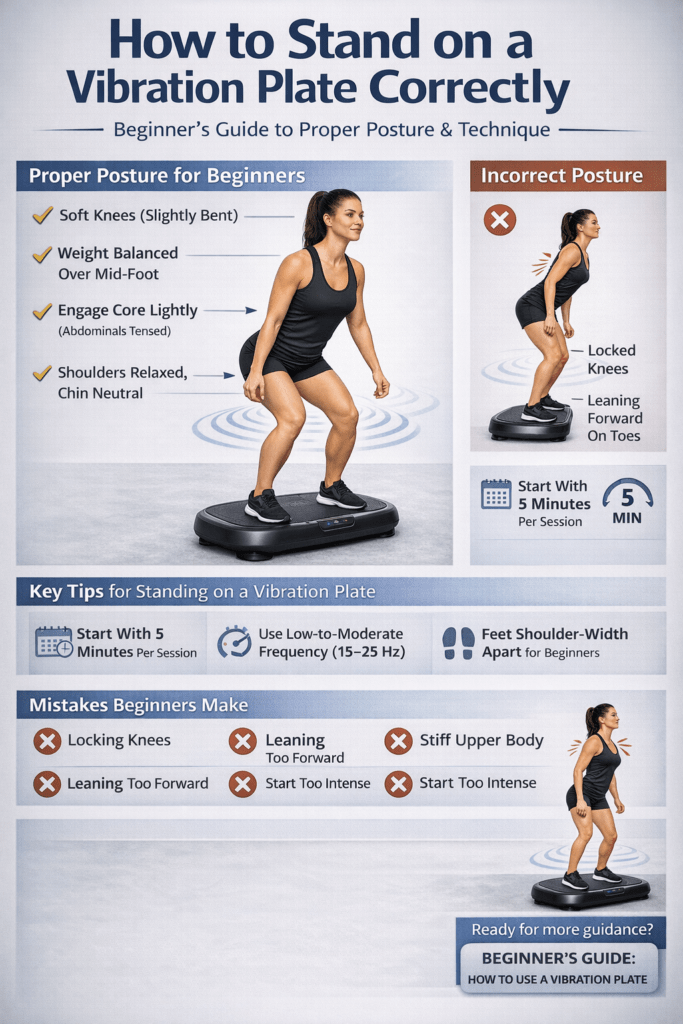
Step 1: Soft Knees — Always
This is non-negotiable.
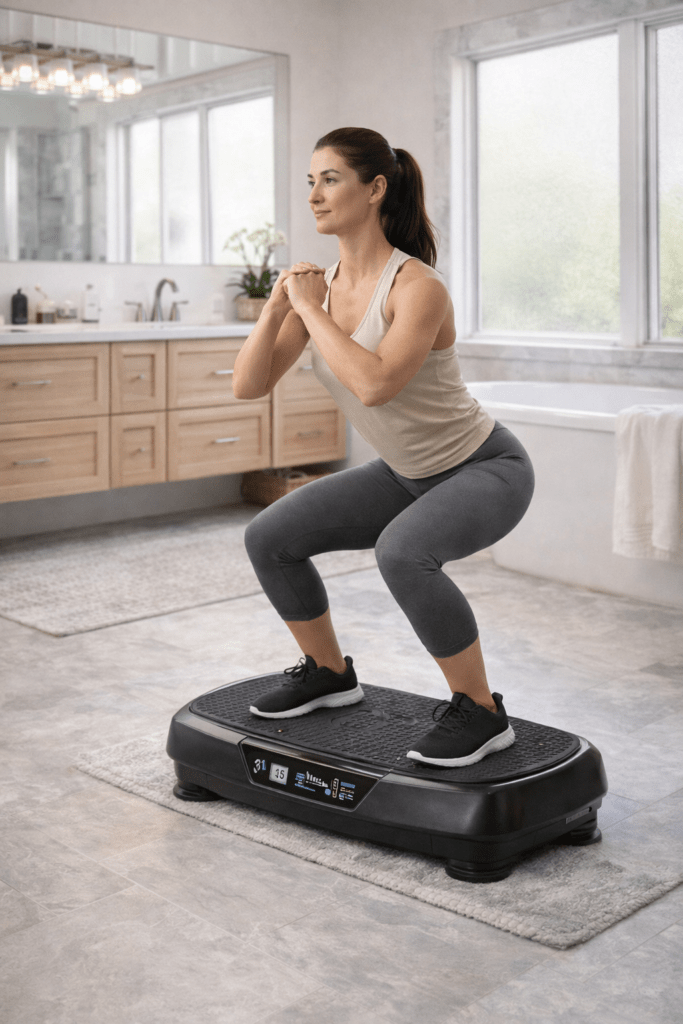
When you stand on a vibration plate, keep a slight bend in your knees. Think “mini squat,” not locked legs.
Why?
When knees are locked:
- Vibration travels directly into your joints and spine.
- Muscle activation decreases.
- You may feel discomfort in your head or neck.
When knees are softly bent:
- Your quadriceps, hamstrings, and glutes absorb the vibration.
- Muscle spindles activate properly.
- You get the neuromuscular benefit without excess joint stress.
I usually tell beginners to imagine they’re about to sit back into a chair — but only halfway.
Step 2: Weight Balanced Over Mid-Foot
Don’t lean too far forward or backward.
Your weight should be evenly distributed:
- Not on your toes.
- Not on your heels.
- Centered over the mid-foot.
If you lean forward, your calves take over.
If you lean back, your lower back absorbs more force.
Balanced posture allows vibration to travel efficiently through the legs and hips — where you want the activation.
Step 3: Engage Your Core Lightly
You don’t need to brace like you’re lifting heavy weights.
But a gentle abdominal engagement helps:
- Stabilize your spine.
- Improve balance.
- Increase muscle recruitment.
Think of it as “standing tall with awareness.”
Step 4: Shoulders Relaxed, Chin Neutral
One of the most common beginner mistakes is tensing the upper body.
Your shoulders should be relaxed.
Unclench your jaw.
Your chin neutral (not jutting forward).
If you feel vibration in your head, it’s often because:
- Knees are too straight.
- Frequency is too high.
- Posture is stiff.
Adjust posture first before lowering intensity.
Where Should Your Feet Be?
Foot placement affects intensity.
- Feet shoulder-width apart = moderate intensity (ideal for beginners).
- Wider stance = more lower-body engagement.
- Narrow stance = more balance challenge.
On oscillating plates (side-to-side movement), foot position significantly changes load. Learn more in our comparison of
https://vibrationforhealth.com/linear-vs-oscillating-vibration-plates/
How Long Should You Stand?
If you’re just starting:
- 5 minutes total
- Low-to-moderate frequency (15–25 Hz)
- 1-minute intervals with rest between
Don’t jump straight into 15 minutes at high intensity. Your nervous system needs time to adapt.
Whole-body vibration stimulates rapid muscle contractions — even if it doesn’t “feel” like traditional exercise.
Realistic Expectations for Beginners
Let’s clear something up.
Standing properly on a vibration plate will:
- Improve muscle activation.
- Enhance balance.
- Boost circulation.
- Help you feel “engaged” quickly.
It will not:
- Replace strength training.
- Instantly melt fat.
- Transform your body in two weeks.
Most beginners notice:
- Slight muscle fatigue within minutes.
- Improved balance after 2–4 weeks.
- Better muscle tone after consistent 4–6 week use.
Consistency beats intensity.
Common Beginner Mistakes
- Locking knees
- Standing too stiff
- Using maximum frequency immediately
- Expecting dramatic soreness
- Looking down constantly (which strains the neck)
Fix posture before changing settings.
If you’re unsure about proper programming, review our beginner guide here:
https://vibrationforhealth.com/how-to-use-a-vibration-plate/
Trade-Offs and Risks
Whole-body vibration is generally safe for healthy adults, but posture mistakes increase risk.
Potential issues include:
- Joint irritation (if knees are locked)
- Lower back strain (if leaning backward)
- Head discomfort (if intensity is too high)
- Fatigue from overuse
Avoid WBV if you have:
- Pacemakers
- Recent fractures
- Severe cardiovascular instability
- Pregnancy (unless cleared by a physician)
Moderation matters.
More vibration does not equal better results.
Decision Guidance: Is Passive Standing Enough?
Here’s something I tell beginners: Standing still is a starting point — not the end goal.
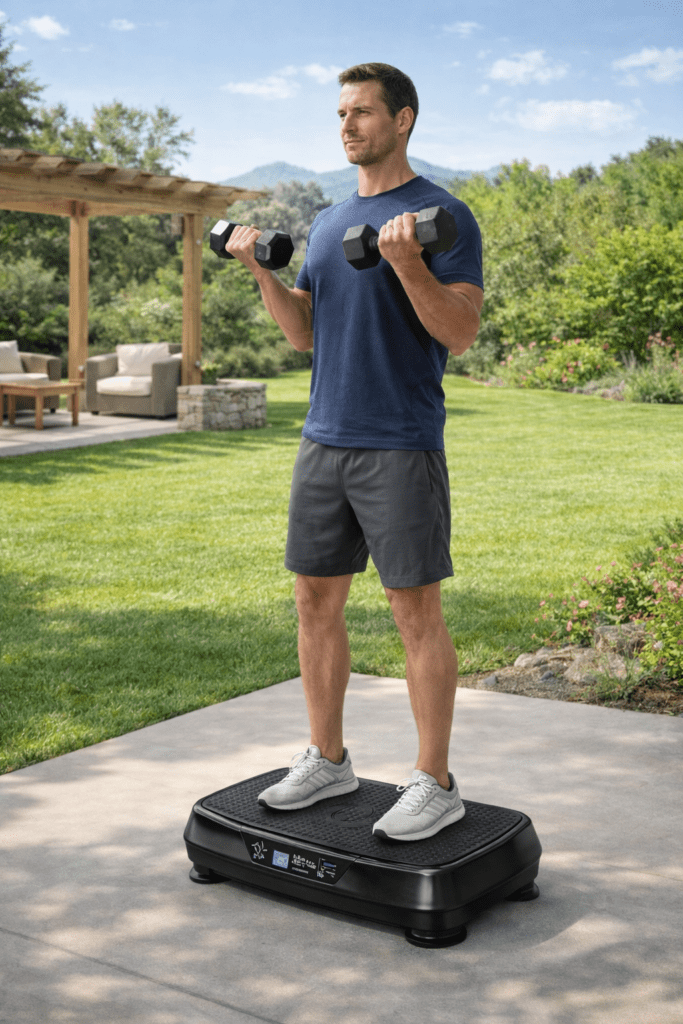
Once posture feels natural, you can progress to:
- Light squats
- Calf raises
- Split stance holds
- Upper-body movements
Movement increases effectiveness dramatically. If you’re only passively standing for months, results will plateau. WBV works best when paired with intentional movement.
What Proper Standing Should Feel Like
You should feel:
- Gentle shaking in your legs.
- Light core engagement.
- A circulation “buzz” afterward.
You should not feel:
- Headache.
- Sharp joint pain.
- Lower back compression.
- Jaw or neck tension.
If you do, reduce intensity and recheck posture.
Frequently Asked Questions
Should my knees be deeply bent?
No, a slight bend is enough. However, too deep turns it into a squat workout rather than a neuromuscular activation session.
Can I stand barefoot?
Yes, many prefer barefoot for better proprioception. Supportive shoes are fine if you need them.
What frequency should beginners use?
15–25 Hz is typically appropriate for starting out.
How many times per week?
3–4 sessions per week is effective for most beginners.
Is it normal to feel tired quickly?
Yes, reflexive muscle contractions can fatigue muscles faster than expected.
Reputable Resources for More Information
- Mayo Clinic — Whole-Body Vibration Overview
https://www.mayoclinic.org/healthy-lifestyle/fitness/expert-answers/whole-body-vibration/faq-20057958 - PubMed — Research On Whole-Body Vibration And Neuromuscular Activation
https://pubmed.ncbi.nlm.nih.gov/ - National Institutes Of Health (NIH) Database
https://www.nih.gov/ - American Council On Exercise (ACE) Research On Vibration Training
https://www.acefitness.org/
Conclusion
Standing correctly on a vibration plate isn’t complicated — but it is intentional.
Soft knees.
Balanced weight.
Relaxed upper body.
Moderate settings.
Start simple and stay consistent. Progress gradually. Whole-body vibration is a tool — and like any tool, its effectiveness depends on how you use it. Master the basics first – your muscles (and joints) will thank you.