If you’ve ever stood on a vibration plate and thought, “Okay… but what is actually happening inside my body right now?” — you’re not alone.
Whole-body vibration (WBV) sounds complicated, but the concept is surprisingly simple once you understand the mechanics. I’ve worked with vibration platforms long enough to see where people get confused — especially around frequency, amplitude, reflexes, and the difference between whole-body and local vibration therapy.
Let’s break this down in plain English.
What Is Whole-Body Vibration?
Whole-body vibration is a form of exercise or therapy where you stand, sit, or perform movements on a platform that rapidly oscillates. The plate moves up and down (or side to side), sending mechanical vibrations through your body.
Those vibrations cause your muscles to contract reflexively — meaning you don’t consciously “flex,” but your nervous system automatically activates muscle fibers in response.
The key variables are:
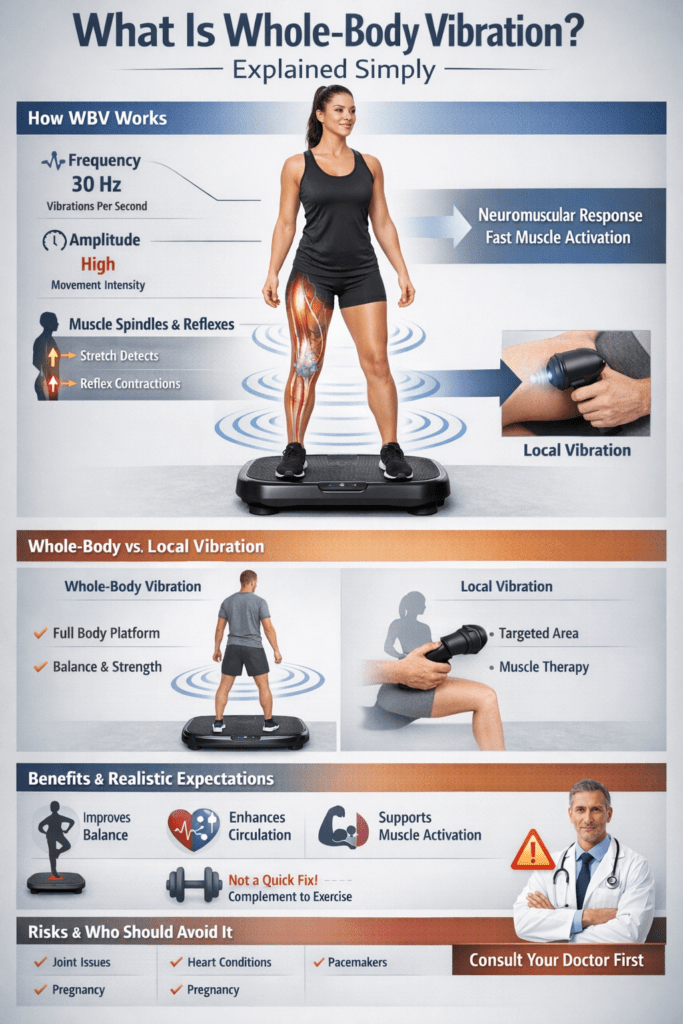
1. Frequency (How Fast It Vibrates)
Measured in Hertz (Hz), frequency tells you how many times per second the plate moves.
- 10 Hz = 10 movements per second
- 30 Hz = 30 movements per second
Lower frequencies (5–15 Hz) are typically used for balance and mobility.
Mid-range (20–35 Hz) targets muscle activation and strength.
Higher frequencies can increase intensity but aren’t always better.
2. Amplitude (How Far It Moves)
Amplitude refers to how big the movement is — usually measured in millimeters.
- Low amplitude = smaller, more subtle movement
- High amplitude = deeper, stronger displacement
Higher amplitude increases intensity, but also joint stress.
3. Acceleration (Combined Effect)
Acceleration depends on both frequency and amplitude. This determines how much force your body experiences.
This is why simply looking at “max Hz” on a product page doesn’t tell the full story. Frequency without amplitude context is incomplete.
If you’re comparing models, I’d strongly suggest reviewing our detailed breakdown on vibration plate types and how they differ before making a decision.
How Does WBV Actually Work Inside the Body?
Here’s where it gets interesting.
When the plate moves, it slightly stretches your muscles. Inside those muscles are sensory receptors called muscle spindles.
Muscle spindles detect stretch.
When they sense rapid stretching (from vibration), they send a signal to your spinal cord. Your nervous system responds instantly by contracting the muscle. This is called the stretch reflex.
This process repeats dozens of times per second.
If the plate vibrates at 30 Hz, your muscles may contract 30 times per second — automatically.
You’re not consciously doing it.
Your nervous system is.
This rapid reflexive contraction improves:
- Neuromuscular coordination
- Muscle recruitment
- Balance response
- Circulation
It’s essentially a neurological workout layered on top of whatever position or exercise you’re doing.
That’s the foundation of whole-body vibration.
Whole-Body vs. Local Vibration Therapy
These are often confused.
Whole-Body Vibration (WBV)
- You stand, sit, or perform exercises on a vibration platform.
- Vibrations travel through large portions of your body.
- Used for strength, balance, circulation, bone density support, and general conditioning.
Local Vibration Therapy
- Applied to one muscle group or small area.
- Often delivered with handheld devices or therapeutic tools.
- Used in physical therapy, pain management, or muscle recovery.
Local vibration isolates.
Whole-body vibration integrates.
If you’re looking for systemic benefits like improved balance, metabolic activation, or bone density support, WBV is typically the better fit.
If you’re addressing a single injury site, local therapy may make more sense.
What Muscle Activation Feels Like
New users often expect to feel like they’re doing a traditional workout.
WBV feels different.
You might notice:
- Subtle shaking in your legs
- A buzzing sensation in your muscles
- Faster fatigue in positions like squats
- Tingling circulation boost afterward
You don’t get the same “burn” as lifting heavy weights — but neuromuscular activation is happening beneath the surface.
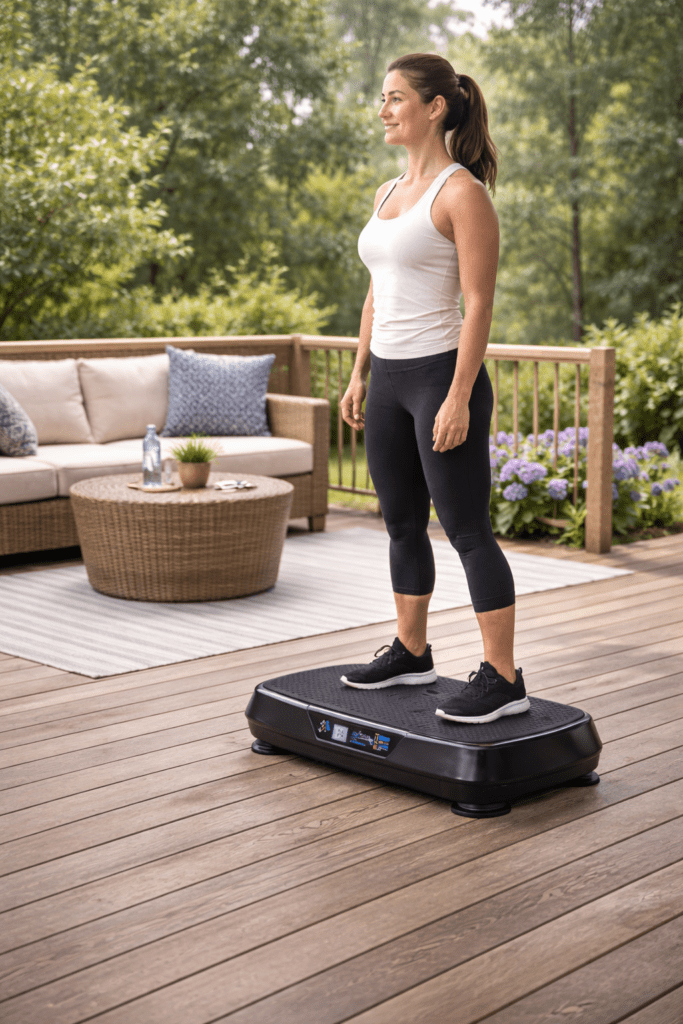
The effectiveness often depends on posture. Locked knees reduce activation. Soft knees increase it.
That’s why positioning guidance matters. See our guide on how to stand properly on a vibration plate if you’re just getting started.
Realistic Expectations
Let’s be clear about something.
Whole-body vibration is not magic.
It will not:
- Replace resistance training
- Melt fat instantly
- Fix chronic disease on its own
It can:
- Improve balance and coordination
- Enhance circulation
- Support muscle activation
- Complement strength training
- Assist older adults with stability
Results depend on consistency and intensity.
Used 3–4 times per week for 10–15 minutes, most people notice improved muscle tone and balance within 4–6 weeks.
But if you stand on it passively once a week, nothing meaningful will happen.
Trade-Offs and Risks
WBV is generally safe for healthy individuals, but there are trade-offs.
Potential Risks:
- Overuse at very high frequencies
- Aggravation of joint issues
- Head discomfort if posture is poor
- Not recommended during pregnancy
- Not advised for people with certain cardiovascular or implanted device conditions
If you have:
- Pacemakers
- Recent fractures
- Severe neuropathy
- Uncontrolled hypertension
You should consult a physician first.
More vibration does not equal better results.
In fact, excessive high-frequency use may cause fatigue or joint irritation. Start moderate.
Decision Guidance: Who Benefits Most?
WBV is especially useful for:
- Adults over 50 wanting balance support
- Busy professionals needing short workouts
- People rehabbing from mild deconditioning
- Individuals wanting low-impact muscle stimulation
- Those adding variety to strength routines
It’s less ideal if:
- You expect it to replace weight training entirely
- You dislike sensation-based workouts
- You have significant spine instability
If you’re comparing specific models, review our comparison of linear vs oscillating vibration plates before buying.
Frequently Asked Questions
How long should I use a vibration plate per session?
10–15 minutes is typical. Beginners may start at 5 minutes.
What frequency is best for beginners?
Start between 15–25 Hz and moderate amplitude.
Can WBV help bone density?
Some research suggests potential benefit for bone stimulation, particularly in postmenopausal adults, but results vary.
Should knees be bent?
Yes. Soft knees improve muscle activation and reduce joint strain.
Is higher Hz better?
Not necessarily. The right combination of frequency and amplitude matters more than max numbers.
Reputable Resources for More Information
- Mayo Clinic — Whole-body vibration overview
- National Institutes of Health (NIH) studies on vibration therapy
- PubMed research on neuromuscular activation and muscle spindle response
- American Council on Exercise (ACE) vibration training research
Conclusion
Whole-body vibration isn’t mysterious once you understand what’s happening.
The plate moves.
Your muscles stretch.
Muscle spindles detect it.
Your nervous system triggers reflex contractions.
That repetition builds neuromuscular engagement.
It’s not a miracle machine — but it’s a useful tool when applied correctly.
Use moderate settings.
Bend your knees.
Be consistent.
Pair it with real movement.
If you approach it intelligently, WBV can become one of the simplest ways to stimulate muscle and balance without high-impact strain.
And that’s where it shines.