I’ve seen vibration plates used brilliantly—and I’ve seen them used in ways that make me want to gently take the remote away. The biggest misconception is that vibration plates are about doing more. In reality, the best results come from doing less, but doing it smarter.
A vibration plate doesn’t reward complexity. It rewards good positions, short sets, and consistency. If you treat it like a circus trick platform, you’ll either burn out or irritate your joints. If you treat it like a tool that amplifies simple movements, it can become one of the easiest workouts to stick with.
Let’s walk through the exercises that actually deliver, how long sessions should be, and how to get the most benefit without overdoing it.
The Golden Rule of Vibration Plate Workouts
Before we get into exercises, this principle matters:
Vibration plates work best with isometric holds and slow, controlled movements.
Fast reps plus vibration often turn into sloppy form. Sloppy form plus vibration is where people get sore knees, numb feet, or dizziness. The goal is to let the vibration increase muscle activation, not chaos.
This approach is echoed across practical vibration plate guidance, which consistently emphasize simple holds and controlled movements over flashy routines.
The Most Effective Vibration Plate Exercises
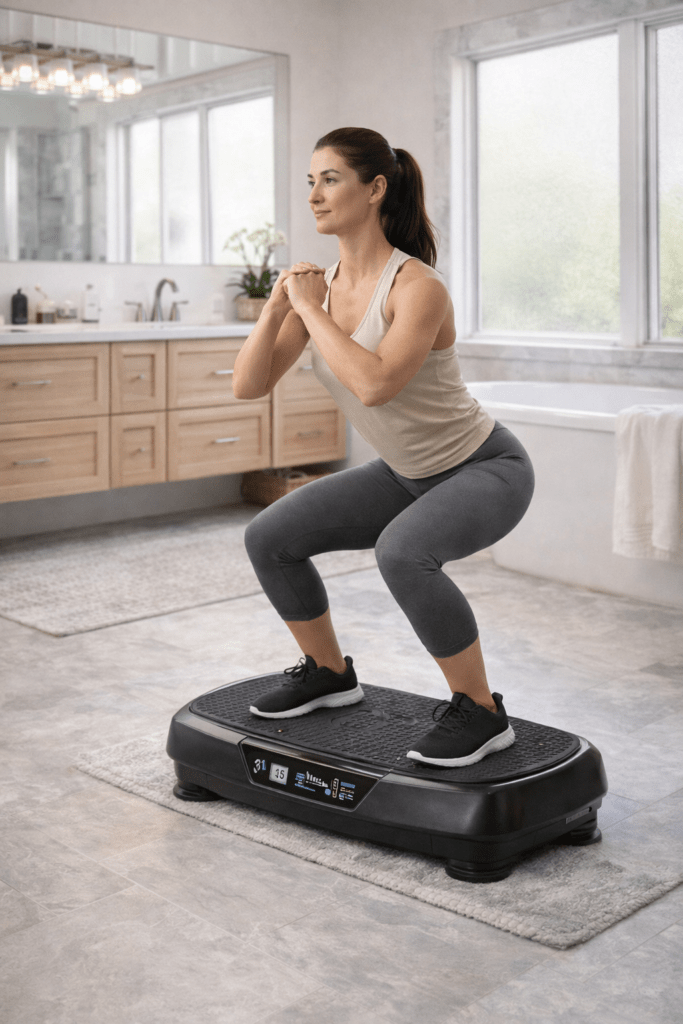
1. Squat Holds (The MVP Exercise)
If you only did one exercise on a vibration plate, this would be it.
Why it works:
- Activates quads, glutes, hamstrings, and core
- Easy to scale (depth, time, stance width)
- Minimal joint impact when done correctly
How to do it:
- Feet shoulder-width apart
- Sit back slightly, chest tall
- Hold for 20–45 seconds
- Rest 30–60 seconds
This single movement delivers more value than 90% of complicated routines.
2. Planks (Hands or Forearms on the Plate)
Planks on a vibration plate light up your core fast.
Why it works:
- Deep core engagement
- Shoulder and hip stabilizers work overtime
- Short sets feel surprisingly intense
Tips:
- Start with hands on the plate (easier)
- Progress to forearms only if it feels controlled
- Keep sets short: 15–30 seconds is plenty
3. Glute Bridges (Feet on Plate)
This is a great option if squats bother your knees or back.
Why it works:
- Strong glute activation
- Low spinal load
- Excellent for people who sit a lot
How to do it:
- Lie on your back, feet on the plate
- Drive hips up, squeeze glutes
- Hold 20–40 seconds
4. Calf Raises (Slow and Controlled)
Calves respond very well to vibration.
Why it works:
- Improves lower-leg strength
- Supports circulation
- Easy to add to warm-ups or recovery days
Do this:
- Rise slowly onto toes
- Hold at the top for 2–3 seconds
- 10–15 slow reps or 30-second holds
This exercise pairs especially well with lymphatic-focused sessions discussed here.
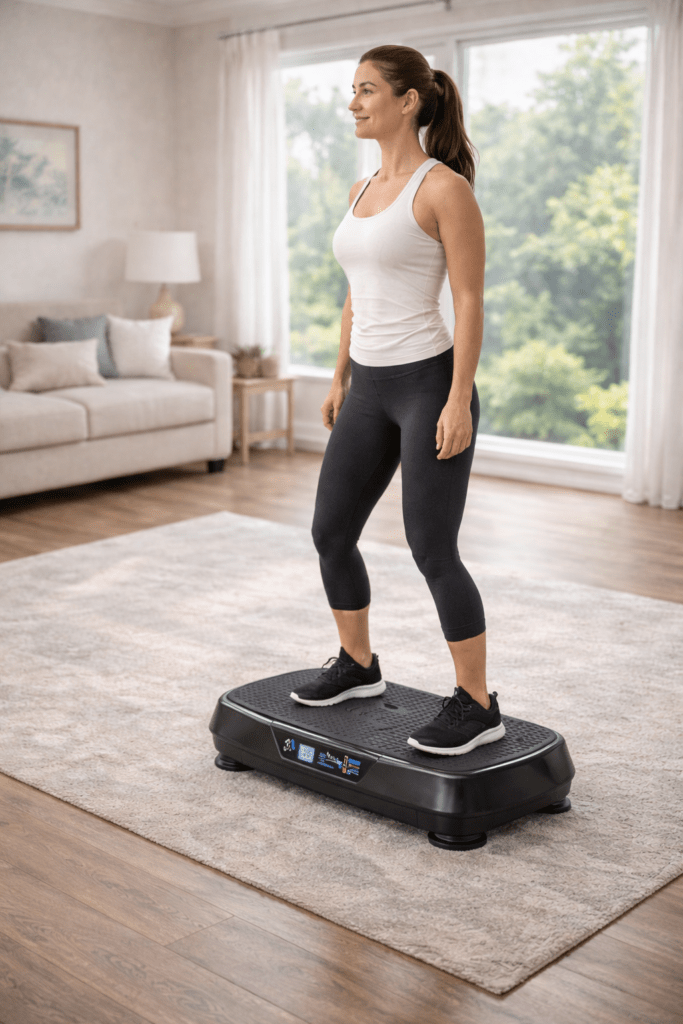
5. Gentle Standing (Yes, Really)
Standing with soft knees isn’t “lazy” if your goal is:
- circulation
- recovery
- light activation on low-energy days
It’s one of the most common daily-use patterns people stick with long-term.
Exercises That Look Cool but Often Underperform
From experience, these are usually not worth it, especially for beginners:
- Fast jumping or plyometrics on high settings
- Heavy dumbbell lifts at high vibration
- One-legged balance tricks before you’ve built tolerance
They increase risk without adding much benefit.
Optimal Workout Length (This Is Where People Mess Up)
Here’s the honest answer:
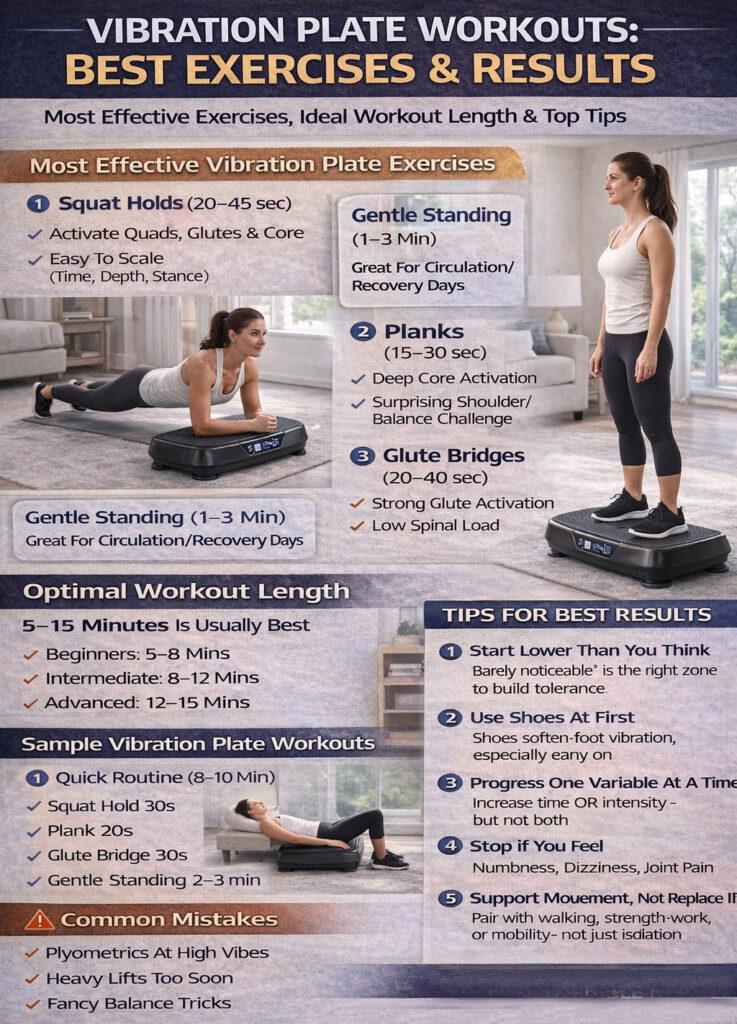
5–15 minutes is the sweet spot
- Beginners: 5–8 minutes total
- Intermediate: 8–12 minutes
- Advanced: 12–15 minutes
More time does not equal more results. Past a certain point, stabilizers fatigue and form breaks down.
Vibration plate research and practical guidance repeatedly emphasize short, focused sessions rather than long workouts.
Sample Vibration Plate Workouts
Quick Daily Routine (8–10 minutes)
- Squat hold – 30 sec
- Rest – 30 sec
- Plank – 20 sec
- Rest – 40 sec
- Glute bridge – 30 sec
- Rest – 30 sec
- Gentle standing – 2–3 minutes
Recovery / Circulation Day (5–10 minutes)
- Gentle standing – 2 min
- Calf raises – 1 min
- Seated feet on plate – 2–3 min
- Slow breathing – 1–2 min
These types of sessions align closely with how many people successfully use vibration plates long-term, rather than treating them like traditional gym workouts.
Tips to Get the Best Results (Without Overdoing It)
1. Start Lower Than You Think
If vibration is “barely noticeable,” you’re probably in the right zone to build consistency.
2. Use Shoes at First
Shoes reduce excessive vibration into the feet and ankles, especially early on.
3. Progress One Variable at a Time
Increase time OR intensity OR exercise difficulty—not all three.
4. Stop If You Feel:
- dizziness
- numbness
- joint pain
Vibration plates are a stimulus, not a test of toughness.
5. Use It to Support Movement, Not Replace It
Vibration plate workouts pair best with walking, strength training, or mobility work—not isolation.
Trade-Offs and Risks to Be Aware Of
Trade-offs
- Great for activation, not maximal strength
- Convenient, but not a full fitness solution
- Works best with patience, not intensity chasing
Risks
People who are pregnant, have pacemakers, recent surgery, or certain cardiovascular conditions should consult a clinician first. Heart-related considerations are discussed here.
Frequently Asked Questions
Are vibration plate workouts enough on their own?
They can support fitness, but most people get best results combining them with walking, strength training, or mobility work.
Should I exercise or just stand?
Standing works for circulation. Exercises increase muscle activation. Both have value.
How often should I do vibration plate workouts?
Most people do well with 3–5 sessions per week, depending on intensity.
Can older adults use vibration plates?
Often yes, especially for balance and circulation, when intensity is kept appropriate.
Conclusion
The best vibration plate workouts are simple, short, and repeatable. Squat holds, planks, glute bridges, and gentle standing deliver far more benefit than complicated routines. Aim for 5–15 focused minutes, respect recovery, and use the plate to enhance movement—not replace it.