If you’ve been researching vibration plates, you’ve probably noticed three terms that keep popping up: vertical, oscillating, and dual vibration. On the surface, they all sound similar—after all, the platform vibrates. But in practice, these motion types feel very different on your body and deliver different training effects.
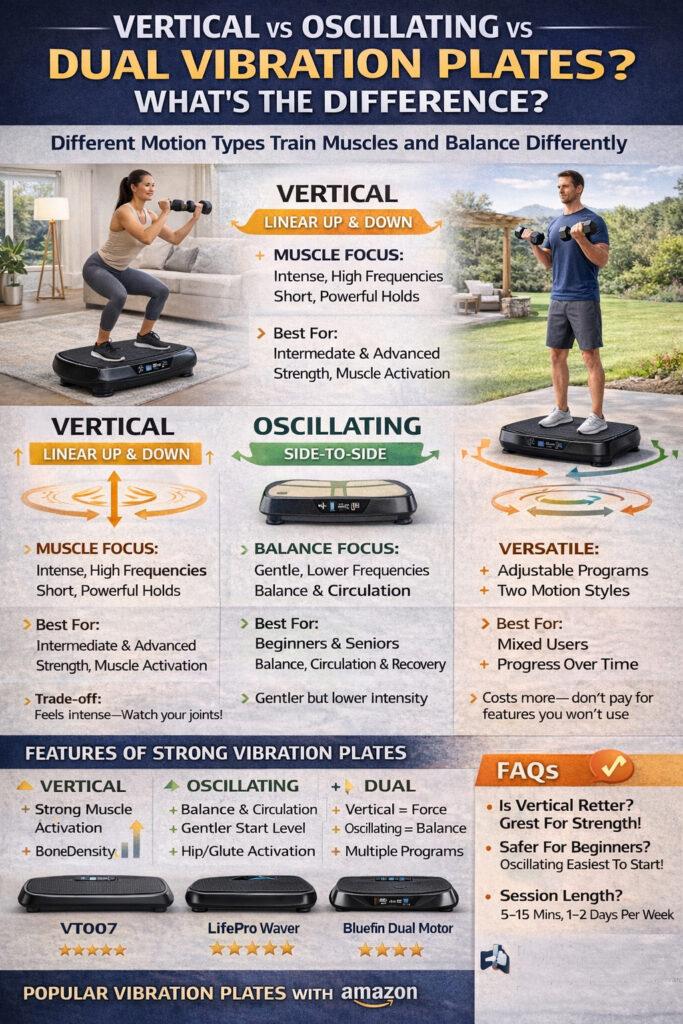
I’ve spent a lot of time standing, squatting, and planking on all three styles, and the biggest mistake people make is assuming vibration is vibration. It’s not. The direction of motion changes how your muscles fire, how your balance is challenged, and how comfortable the plate feels long-term.
Let’s break this down in a practical way so you can choose the right motion type for your goals.
The Three Main Types of Vibration Motion
1. Vertical (Linear) Vibration
What it is:
The platform moves straight up and down. Both feet rise and fall together.
What it feels like:
Clean, direct, and intense—especially at higher frequencies. You’ll feel it immediately in your legs and core.
How it affects muscles:
Vertical vibration sends force directly through the body, which tends to create strong muscle activation. This is why vertical plates are often associated with:
- Strength-style holds (squats, lunges, planks)
- Muscle recruitment and tension
- Higher perceived intensity in shorter sessions
Who it’s best for:
- Intermediate to advanced users
- People who want a more “gym-like” stimulus
- Users focused on strength, muscle activation, or bone-loading exercises
Trade-off:
Vertical vibration can feel aggressive. If the amplitude or frequency is too high, joints and connective tissue can take a beating. This is not the style you want to jump into at max settings on day one.
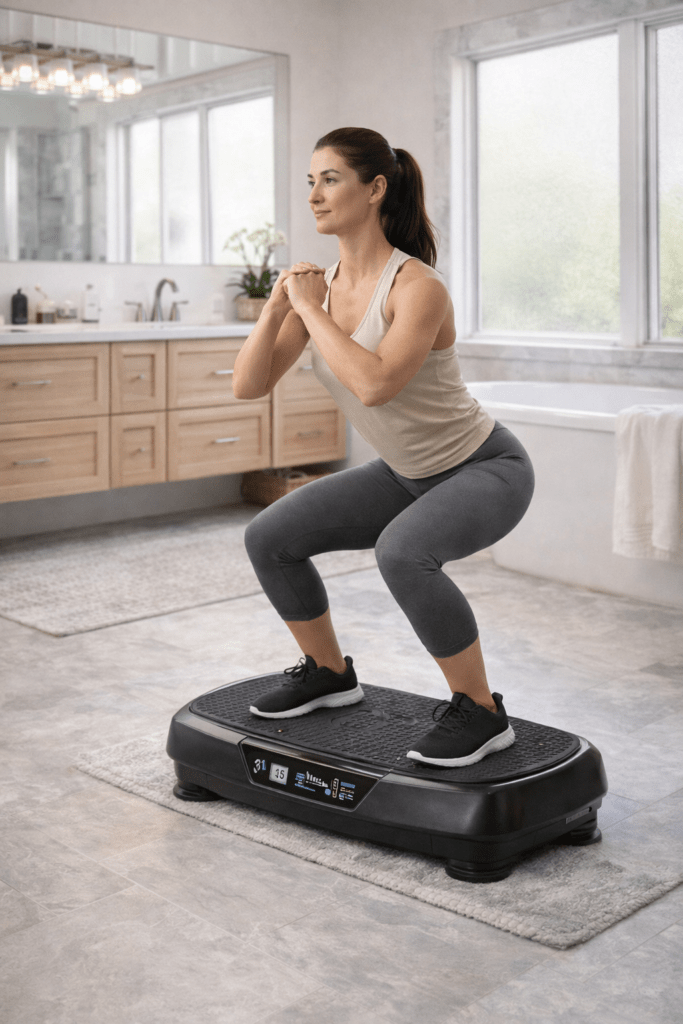
2. Oscillating (Side-to-Side / Pivotal) Vibration
What it is:
The platform tilts left and right around a central pivot, similar to a see-saw.
What it feels like:
More natural and rhythmic. One foot goes up as the other goes down.
How it affects muscles and balance:
Oscillating plates create subtle instability, which forces your stabilizing muscles to engage continuously. This motion tends to:
- Challenge balance more than vertical plates
- Activate hips, glutes, and core stabilizers
- Feel gentler at lower settings
Who it’s best for:
- Beginners
- Older adults
- Balance training, circulation, and mobility work
- People who want something they’ll actually use daily
This motion style aligns well with many balance and recovery principles, especially for people easing into vibration training:
- https://www.vibrationforhealth.com/vibration-plate-health-benefits/
- https://www.vibrationforhealth.com/whole-body-vibration-machine/
Trade-off:
Oscillating plates usually operate at lower frequencies. They’re excellent for consistency and comfort, but they may not deliver the same peak muscle tension as vertical vibration for advanced strength work.
3. Dual Vibration (Vertical + Oscillating)
What it is:
A combination system that allows both linear (up-down) and oscillating motion—either in separate modes or blended together.
What it feels like:
Versatile. You can dial things down for recovery days or crank up intensity for strength-focused sessions.
How it affects training:
Dual-motion plates give you the most flexibility:
- Vertical mode for muscle activation
- Oscillating mode for balance and circulation
- Adjustable programs to match different days and goals
This versatility mirrors how many people actually train: not every workout needs to be intense. Some days are about recovery and movement quality.
Who it’s best for:
- Households with multiple users
- People who want one plate to “do it all”
- Anyone planning to progress over time
Trade-off:
Dual systems are usually more expensive and slightly more complex. If you know you’ll only ever use one motion type, you may be paying for features you won’t touch.
How Motion Type Changes Muscle and Balance Demands
Here’s the practical difference most people notice:
- Vertical vibration: muscles tense against force
- Oscillating vibration: muscles stabilize against imbalance
- Dual vibration: lets you train both qualities
Neither approach is “better”—they’re just different tools. Think of it like choosing between free weights, balance boards, or resistance bands. Each stresses the body in its own way.
Features to Look For (Beyond Motion Type)
Regardless of vibration style, a good plate should have:
✔ Adjustable Intensity
Not just a high max setting, but usable low-end control.
✔ Stable Platform
Wobble from poor construction is not the same as productive instability.
✔ Weight Capacity That Matches Reality
Look for plates rated 300 lbs or more for better motor consistency.
✔ Clear Controls
You should be able to adjust settings quickly while standing on the plate.
For more guidance on choosing plates that match specific health goals, these internal resources are helpful:
- https://www.vibrationforhealth.com/how-to-use-vibration-plate/
- https://www.vibrationforhealth.com/vibration-plate-workouts/
3 Vibration Plates With Excellent Motion Features (Amazon)
These models represent strong examples of each vibration style:
- LifePro Waver Vibration Plate (Oscillating)
- Gentle side-to-side motion
- Excellent for balance and daily use
- Popular with beginners and recovery-focused users
- VT007 Vibration Platform (Vertical / Linear)
- True vertical vibration
- Wide frequency range
- Strong choice for strength and muscle activation
- Bluefin Fitness Dual Motor Vibration Plate (Dual Motion)
- Multiple vibration modes
- Good balance of comfort and intensity
- Ideal for mixed-use households
Trade-Offs, Risks, and Realistic Expectations
Important risks to consider
- High-intensity vibration can irritate joints if overused
- People with joint replacements, pacemakers, or certain medical conditions should consult a clinician first
- More motion ≠ better results
Realistic expectations
A vibration plate won’t replace traditional exercise. What it can do is:
- Enhance muscle activation during static holds
- Improve circulation on low-energy days
- Add balance and stability challenges without heavy loading
Used consistently and sensibly, vibration training becomes a useful support tool, not a miracle solution.
Frequently Asked Questions
Is vertical vibration better than oscillating?
Not universally. Vertical tends to feel more intense, while oscillating is easier to tolerate and better for balance.
Which is safer for beginners?
Oscillating vibration is generally more forgiving and easier to ease into.
Do dual vibration plates work better?
They work best if you actually use both modes. Otherwise, simplicity often wins.
How long should sessions be?
Most people do well with 5–15 minutes, depending on intensity and experience.
Reputable Resources for More Information
- PubMed Central (NIH): Whole-body vibration and muscle activation research
- Mayo Clinic: Exercise safety and balance training
Conclusion
The biggest takeaway is this: motion type matters more than marketing numbers. Vertical vibration emphasizes force and muscle tension. Oscillating vibration challenges balance and coordination. Dual systems offer flexibility if you want variety.
Choose the motion that fits how you actually move, recover, and train. When the vibration plate feels good and fits your goals, you’re far more likely to stick with it—and that’s where real results come from.