
I’ve noticed most people buy a vibration plate, try it twice, crank the intensity way too high, feel a little weird (or get sore in the wrong places)… and then it becomes a coat rack.
That’s a shame, because when you use a vibration plate correctly, it can be a fantastic “multiplier” for your warm-ups, balance work, mobility, and light strength days. The win isn’t doing more. The win is making simple moves more effective—without pounding your joints.
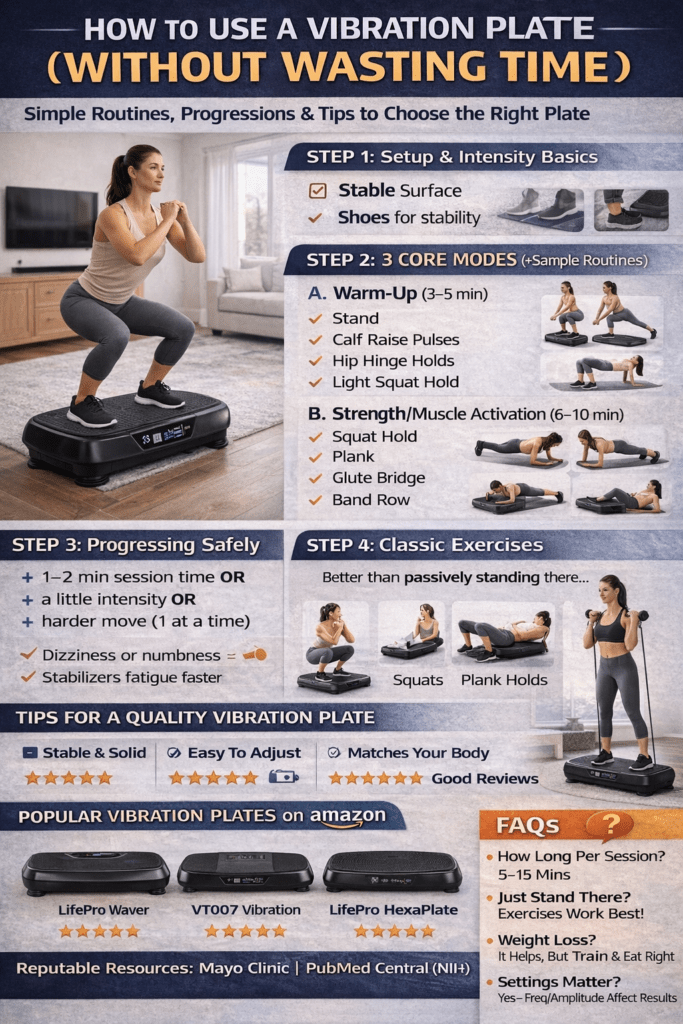
And yes: it’s also true that whole-body vibration shouldn’t replace traditional exercise if your goal is weight loss or overall fitness (Mayo Clinic says it’s best used alongside aerobic + strength training, and to check with a doctor in certain situations).
Let’s make this practical.
Before You Start: Safety + Who Should Be Cautious
A vibration plate is still a stressor. It raises muscle activation and can nudge heart rate and perceived exertion up. If you’re pregnant, have significant cardiovascular disease, a pacemaker/implanted device, recent surgery, or acute injury, don’t guess—get clearance first. Mayo Clinic explicitly flags situations where WBV may be harmful and recommends checking with your doctor if you have health problems or are pregnant.
Also: start low. Many issues people blame on the plate (headache, dizziness, numb feet) are actually “too much too soon.”
Step 1: Set Up Your Plate Like You Mean It
Placement
- Put it on a firm, flat surface (hard floor beats thick carpet).
- If you’re upstairs or noise-sensitive, use a thin vibration mat—not a fluffy rug that makes the plate wobble.
Footwear
- Beginners often do best with shoes for stability.
- Barefoot can feel “stronger,” but it also amplifies intensity into ankles/feet.
Posture check
- Stand tall, soften your knees, and keep your ribcage stacked over your hips.
- If your teeth are chattering, you’re too rigid or too high on intensity.
Step 2: Pick the Right Intensity (The Secret is “Barely Noticeable”)
For your first week, your goal is not to “feel crushed.” Your goal is to build tolerance so you can use it consistently.
A simple progression:
- Days 1–3: 5 minutes total, low intensity
- Days 4–7: 6–10 minutes total, low-to-moderate intensity
- Week 2+: 10–15 minutes total, moderate intensity (if it feels good)
A lot of people get better results doing short sessions consistently (plus practical, consistent usage patterns).
Step 3: Use These 3 “Core” Modes (So It Actually Helps Your Goals)
Mode A: Warm-Up (3–5 minutes)
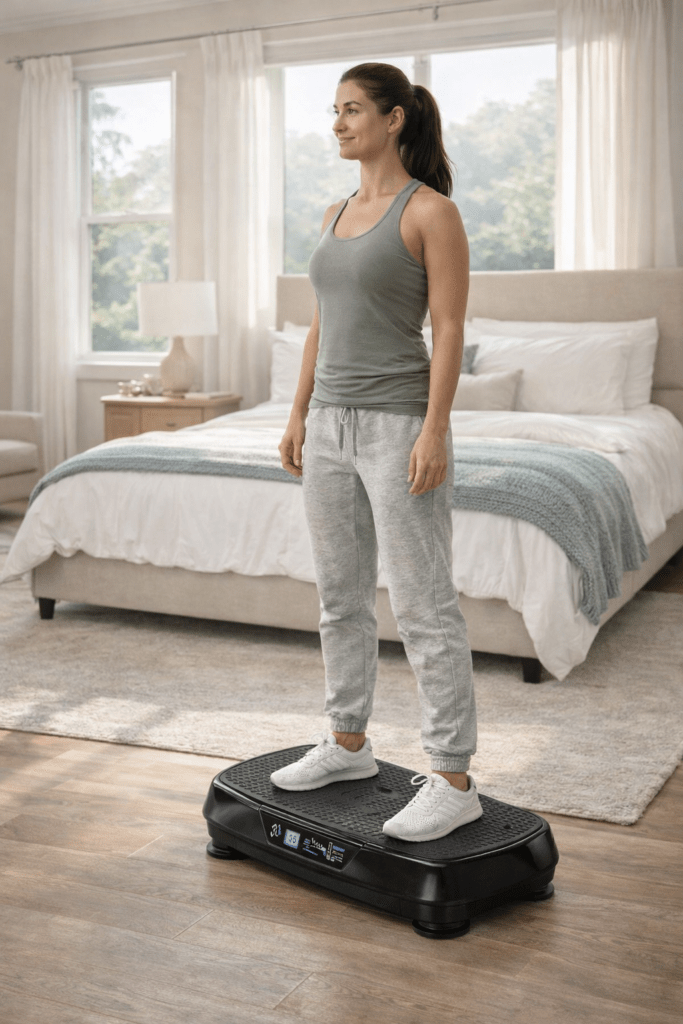
This is the easiest way to get value without overthinking it.
Do:
- Stand with soft knees (30–60 sec)
- Calf raise pulses (30–60 sec)
- Hip hinge holds (30–60 sec)
- Light squat hold (20–40 sec)
This is how you “turn on” legs and core without heavy loading.
Mode B: Strength + Muscle Activation (6–10 minutes)
Vibration plates shine when you add basic exercises. For eaxmple, simple staples (squats, planks, etc.) rather than just standing passively.
Sample circuit (2 rounds):
- Squat hold – 30 sec
- High plank with hands on plate – 20 sec
- Glute bridge (feet on plate) – 30 sec
- Standing row with bands – 30 sec
Rest 30–60 seconds between moves.
Mode C: Recovery + Circulation (5–10 minutes)
This is the “I’m tired but I still want to do something” day.
Do:
- Gentle standing
- Seated feet-on-plate
- Light calf pumps
- Slow breathing
Find out more on circulation/lymph-drainage as a common reason people use these machines.
Step 4: Progress Like a Pro (Without Beating Up Your Joints)
Here’s what actually works long-term:
Progress one variable at a time
- Add 1–2 minutes total session time or
- Increase intensity slightly or
- Add one harder exercise (like a plank variation)
Avoid the common mistake
- Don’t jump from “standing” straight into heavy dumbbell work on a high setting.
- Your stabilizers fatigue faster on vibration. Technique can degrade before you notice.
Watch for red flags
- Tingling/numbness that persists
- Joint pain (knees/hips/back) during or after
- Dizziness that doesn’t fade quickly after stepping off
If those show up, dial intensity down and shorten sessions.
Features to Look For in a Good Vibration Plate
If you want a plate you’ll actually use for months (not days), look for:
- Stable platform + solid weight capacity
A stronger build keeps vibration consistent under load. - Useful adjustability
Not just “99 levels,” but a range you can comfortably start low and grow into. - Motion type that matches your body
Oscillating (side-to-side) often feels more beginner-friendly; linear/vertical can feel more intense. - Easy controls
Remote + clear display matters because you’ll adjust settings mid-session. - Reasonable noise
If it’s annoying, you’ll stop using it. Simple.
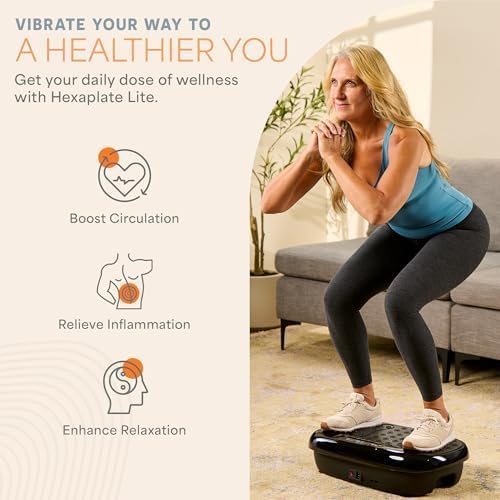
3 Quality Vibration Plates on Amazon
Here are three solid picks that cover different needs (beginner-friendly oscillation, more structured “fitness” use, and a well-known linear option):
- LifePro Waver Vibration Plate (easy entry, popular all-around)
- LifePro HexaPlate Lite (compact, straightforward, lots of guided-style use)
- VT007 Vibration Plate (linear-style option many people seek for a more direct feel)
Helpful Links:
If you want deeper routines and use-cases, these are good supporting pages to interlink:
- Power Plate Machine overview (pros/cons)
- Lymphatic drainage use-case
- Heart-related cautions
- Vibration plate problems
Frequently Asked Questions
How long should I use a vibration plate each session?
Most people do best with 5–15 minutes, especially when starting. Longer isn’t automatically better.
Should I just stand there, or exercise on it?
Standing is fine for warm-up/recovery, but adding simple exercises usually gives more benefit (squats, planks, bridges).
Can it help with weight loss?
It can add a little intensity, but it’s not a replacement for diet + regular training. Mayo Clinic specifically recommends pairing WBV with aerobic and strength training rather than relying on WBV alone.
Do settings (frequency/amplitude) matter?
Yes. Research reviews discuss how WBV “dose” is driven by parameters like frequency and amplitude, and that these affect outcomes.
Conclusion
The “right” way to use a vibration plate is boring in the best way: start low, stay consistent, and use it to enhance simple moves—warm-ups, squat holds, planks, bridges, balance work, and recovery sessions. Don’t chase max intensity. Chase the setting that lets you train with good form and come back tomorrow feeling better, not beat up.