
One of the biggest mistakes I see with whole-body vibration (WBV) is this:
People obsess over the highest Hz number on the display. More is better, right?
Not with vibration.
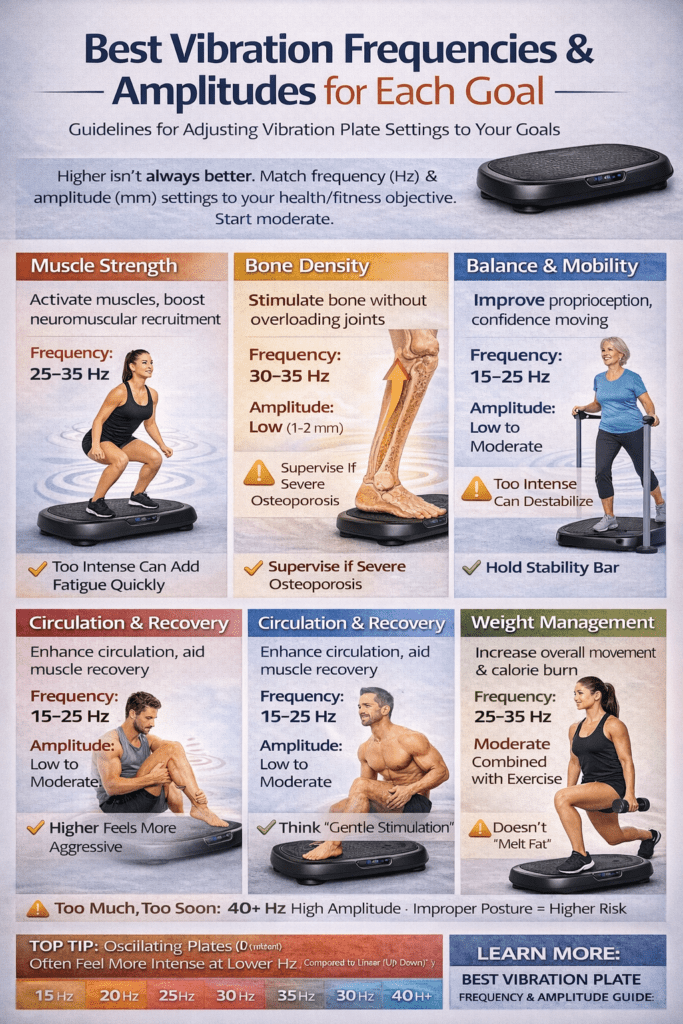
The effectiveness of WBV depends on matching frequency (Hz) and amplitude (how far the plate moves) to your specific goal. Strength requires a different stimulus than circulation. Bone density protocols differ from balance training.
If you’re brand new and need a refresher on what frequency and amplitude actually mean, start here:
https://www.vibrationforhealth.com/whole-body-vibration-explained/
Now let’s get into the practical guide.
First: Quick Definitions (In Plain English)
Frequency (Hz) = How many times per second the plate moves.
20 Hz = 20 vibrations per second.
Amplitude (mm) = How far the plate travels vertically or side-to-side.
Acceleration = Combined effect of both — this determines overall intensity.
Higher frequency + higher amplitude = exponentially more load.
That’s why chasing high numbers without context can backfire.
Goal-Based Frequency & Amplitude Guide
Below are general ranges based on research trends and practical experience. These are not medical prescriptions — they’re programming guidelines.
1️⃣ Muscle Strength & Performance
Goal: Activate muscle fibers, increase neuromuscular recruitment.
Recommended Range:
- Frequency: 25–35 Hz
- Amplitude: Moderate (2–4 mm typical, depending on plate type)
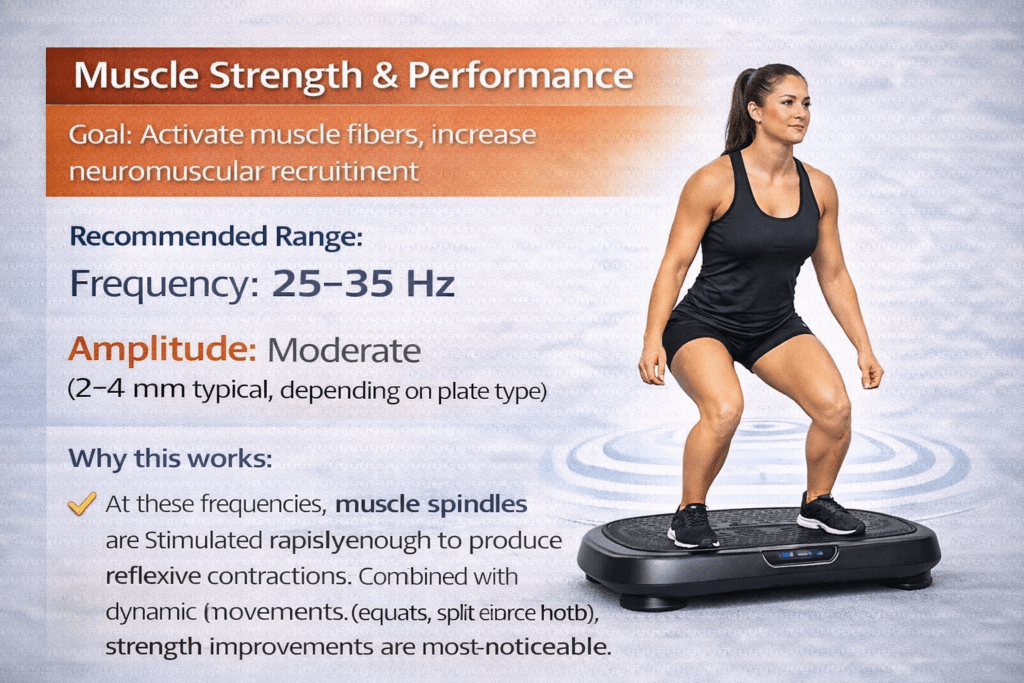
Why this works:
At these frequencies, muscle spindles are stimulated rapidly enough to produce reflexive contractions. Combined with dynamic movements (squats, split stance holds), strength improvements are most noticeable.
Trade-Off:
Higher frequency can increase fatigue quickly. More than 35–40 Hz isn’t automatically better and may increase joint discomfort.
Best Practice:
Use moderate amplitude and pair with movement. Passive standing won’t maximize strength.
2️⃣ Bone Density Support (Postmenopausal Protocols)
Goal: Mechanical stimulation of bone without excessive joint load.
Research often supports:
- Higher frequency
- Lower amplitude
- Consistent cumulative exposure
Recommended Range:
- Frequency: 30–35 Hz
- Amplitude: Low (1–2 mm)
The idea here is subtle mechanical signaling to bone cells without high impact stress.
Important:
If someone has severe osteoporosis or fracture risk, physician supervision is critical.
You can read more about safety considerations here:
https://www.vibrationforhealth.com/whole-body-vibration-safety/
Trade-Off:
Bone adaptation is slow. This is a long-term strategy, not a 4-week solution.
3️⃣ Balance & Mobility (Especially Older Adults)
Goal: Improve neuromuscular coordination and proprioception.
Recommended Range:
- Frequency: 15–25 Hz
- Amplitude: Low to moderate
Lower frequency reduces intensity while still challenging balance reflexes.
This range works well for:
- Older adults
- Rehabilitation patients
- Deconditioned individuals
Trade-Off:
Too high frequency can destabilize rather than improve control.
Start conservative.
4️⃣ Circulation & Recovery
Goal: Promote muscle pump activity and circulation.
Recommended Range:
- Frequency: 15–25 Hz
- Amplitude: Low to moderate
Lower frequency sessions feel smoother and less aggressive. Many people report improved lower-leg circulation at these settings.
Trade-Off:
If you go too high in frequency, the session becomes neuromuscular training instead of recovery-focused.
Think “gentle stimulation,” not “max output.”
5️⃣ Weight Management (With Realistic Expectations)
Let’s be clear: vibration plates are not fat-loss machines.
They can:
- Improve muscle activation
- Increase total daily movement
- Support consistency
For metabolic stimulus:
Recommended Range:
- Frequency: 25–35 Hz
- Amplitude: Moderate
- Combined with dynamic exercises
Movement matters here. Static standing won’t meaningfully impact calorie burn.
Plate Type Matters
Oscillating (pivotal) plates often feel more intense at lower Hz compared to linear plates.
If you’re unsure what type you own, see:
https://www.vibrationforhealth.com/vertical-vs-oscillating-vibration-plate/
Amplitude behaves differently depending on design.
Risks of Incorrect Settings
Here’s what I see most often:
❌ 40+ Hz on day one
❌ High amplitude with locked knees
❌ Daily max-intensity sessions
❌ Ignoring joint discomfort
Higher frequency + high amplitude dramatically increases acceleration.
More isn’t better — it’s just more stress.
Start moderate. Increase gradually.
Practical Programming Advice
For beginners:
Week 1–2:
- 15–20 Hz
- Low amplitude
- 5–8 minutes
Week 3–4:
- 20–30 Hz
- Moderate amplitude
- Add light movement
Beyond 4 weeks:
- Adjust based on goal
- Introduce dynamic positions
- Avoid daily high-intensity sessions
Realistic Expectations
Frequency and amplitude do not replace consistency.
Expect:
- Circulation effects immediately
- Balance improvements in 2–4 weeks
- Strength improvements in 4–8 weeks
- Bone density effects over months
This is a long-game tool.
Frequently Asked Questions
Is higher Hz better?
No. Higher frequency increases intensity, but effectiveness depends on matching settings to your goal.
What’s the safest beginner frequency?
15–20 Hz with low amplitude.
Can I use max settings if I’m athletic?
Even athletes should progress gradually. High settings increase joint stress and fatigue.
Should amplitude always be low?
Not necessarily. Moderate amplitude works well for strength goals, but bone protocols typically use lower amplitude.
How long should sessions last?
5–15 minutes is typical. Longer sessions do not always equal better results.
Reputable Resources for More Information
- Mayo Clinic – Whole-Body Vibration Overview
https://www.mayoclinic.org/healthy-lifestyle/fitness/expert-answers/whole-body-vibration/faq-20057958 - PubMed (NIH) – Research Database
https://pubmed.ncbi.nlm.nih.gov/ - American Council on Exercise (ACE)
https://www.acefitness.org/ - National Institutes of Health (NIH)
https://www.nih.gov/
Conclusion
The best vibration frequency and amplitude aren’t universal.
They’re goal-specific.
- Strength needs moderate-to-high frequency.
- Balance prefers moderate settings.
- Circulation favors lower intensity.
- Bone protocols emphasize consistency and lower magnitude.
The smartest approach?
- Start lower than you think you need.
- Focus on posture.
- Increase gradually.
- Match the setting to the outcome.
That’s how you make whole-body vibration effective — and sustainable.