
Let’s have the honest conversation. Whole-body vibration (WBV) has real potential benefits — strength, balance, circulation, even bone support in certain populations. But online, it’s often presented as a universal solution with zero downside.
That’s not responsible.
Like any physical stimulus, vibration is a stressor. The question isn’t “Is WBV good or bad?” The real question is:
Is it appropriate for your body, your condition, and your goals?
If you’re new, I strongly recommend starting with:
- https://vibrationforhealth.com/what-is-whole-body-vibration/
- https://www.vibrationforhealth.com/how-to-stand-on-vibration-plate/
Posture and proper settings dramatically reduce risk.
Now let’s talk about safety the way it should be discussed — clearly and without hype.
First: WBV Is Generally Safe for Healthy Adults
For most healthy individuals using moderate settings and proper posture, whole-body vibration is considered low risk.
It’s:
- Low impact
- Short duration
- Adjustable in intensity
When used responsibly, it can be gentler on joints than jumping, running, or heavy lifting.
But “generally safe” does not mean “safe for everyone.”
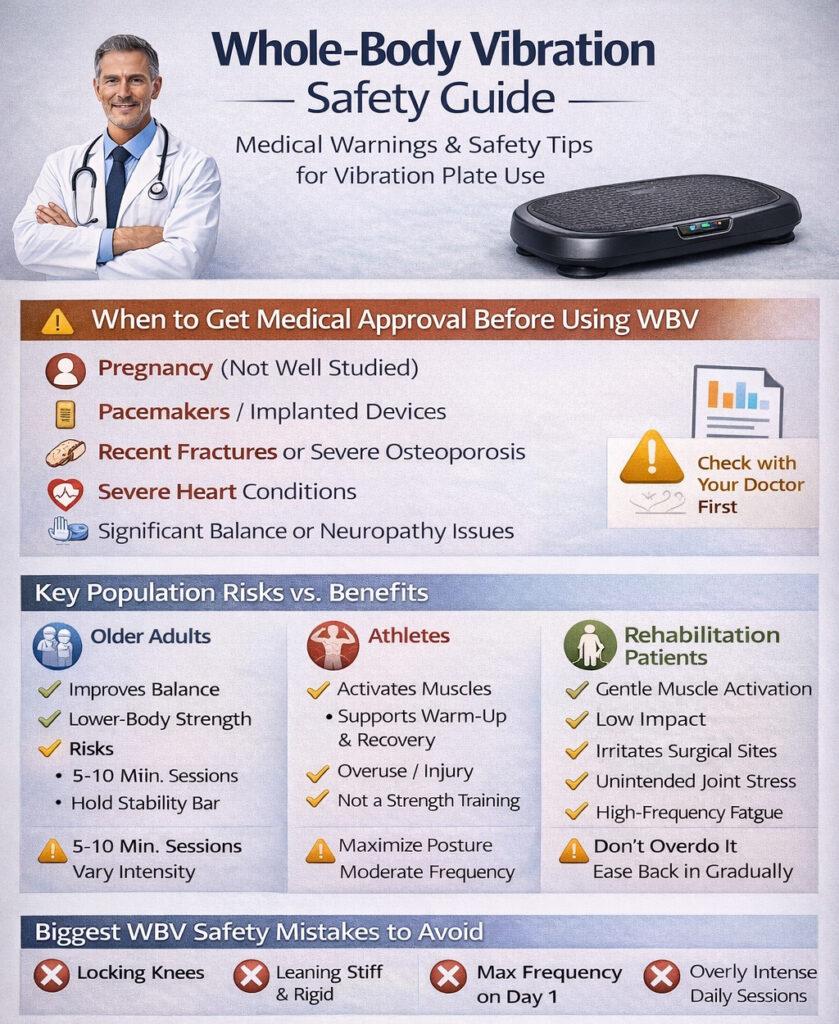
Who Should Avoid WBV (Unless Cleared by a Doctor)
These groups require caution or medical clearance:
1️⃣ Pregnancy
Vibration exposure during pregnancy is not well studied in controlled exercise contexts. Occupational vibration exposure has raised concerns in certain environments.
There’s no strong evidence proving harm from short-term moderate WBV, but there’s also insufficient evidence proving safety.
If pregnant, skip it unless your healthcare provider explicitly approves.
2️⃣ Pacemakers & Implanted Devices
Mechanical vibration could potentially interfere with certain implanted devices.
This is not a “try and see” situation.
If you have:
- Pacemaker
- Defibrillator
- Deep brain stimulator
- Certain spinal implants
Get physician clearance first.
3️⃣ Recent Fractures or Severe Osteoporosis
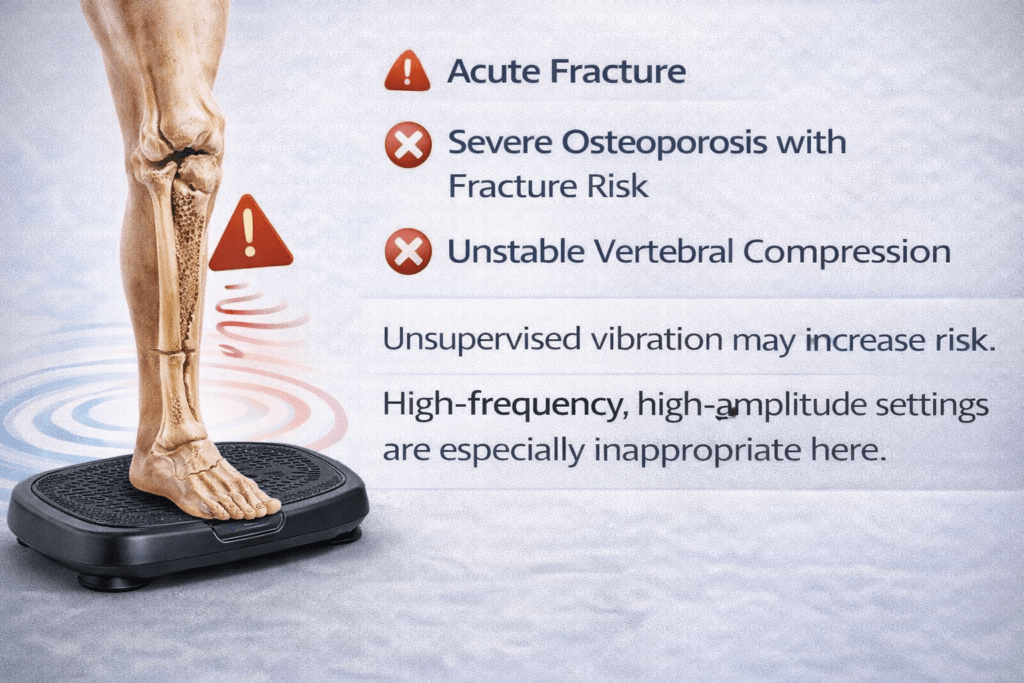
This one is nuanced.
Some research suggests WBV may help bone density in postmenopausal women under structured protocols. But if someone has:
- Acute fracture
- Severe osteoporosis with fracture risk
- Unstable vertebral compression
Unsupervised vibration may increase risk.
High-frequency, high-amplitude settings are especially inappropriate here.
4️⃣ Uncontrolled Cardiovascular Conditions
If someone has:
- Uncontrolled hypertension
- Severe arrhythmia
- Recent cardiac event
They need physician guidance.
WBV increases neuromuscular activation and may transiently affect circulation and heart rate.
For stable, cleared patients, it can sometimes be beneficial. But unstable conditions? Not appropriate without clearance.
5️⃣ Severe Neuropathy or Balance Disorders
WBV challenges proprioception and balance.
For mild balance impairment, it can help.
For severe instability, it increases fall risk.
Supervision matters.
Population-Specific Risk vs Benefit
Let’s break this down by group.
Older Adults
Potential Benefits:
- Improved balance
- Lower-body strength
- Fall risk reduction (when programmed correctly)
Risks:
- Overly high intensity
- Poor posture
- Unsupervised use
- Severe osteoporosis complications
My advice for older adults:
- Start at lower frequencies (15–25 Hz)
- Keep knees softly bent
- Use a support rail if balance is questionable
- Short sessions (5–10 minutes initially)
For this group, the risk is less about vibration itself and more about dosing and supervision.
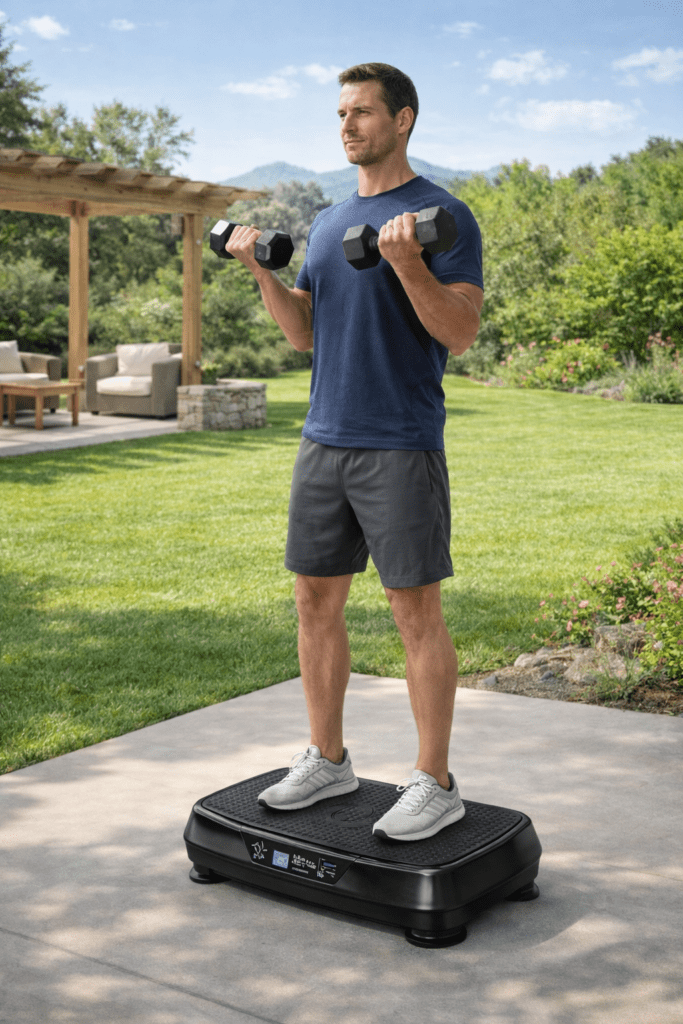
Athletes
Potential Benefits:
- Neuromuscular activation
- Warm-up tool
- Recovery support
Risks:
- Overuse
- Mistaking it for strength training replacement
- Excessive high-frequency sessions
Athletes often push intensity too far.
Higher frequency isn’t automatically better.
WBV works best as a complement — not a primary stimulus.
Rehabilitation Patients
This group varies widely.
Possible Benefits:
- Gentle muscle stimulation
- Early activation after deconditioning
- Low joint stress option
Possible Risks:
- Aggravating surgical sites
- Stimulating inflamed tissues
- Poor neuromuscular control
If someone is post-surgery, in physical therapy, or managing chronic musculoskeletal conditions, WBV should ideally be coordinated with their clinician.
When to Seek Doctor Approval
You should consult your healthcare provider if you have:
- Any implanted medical device
- History of severe cardiovascular disease
- Diagnosed osteoporosis with fracture history
- Recent orthopedic surgery
- Neurological conditions affecting balance
- Chronic unexplained pain
If your body is medically complex, vibration is not a DIY experiment.
Trade-Offs and Realistic Expectations
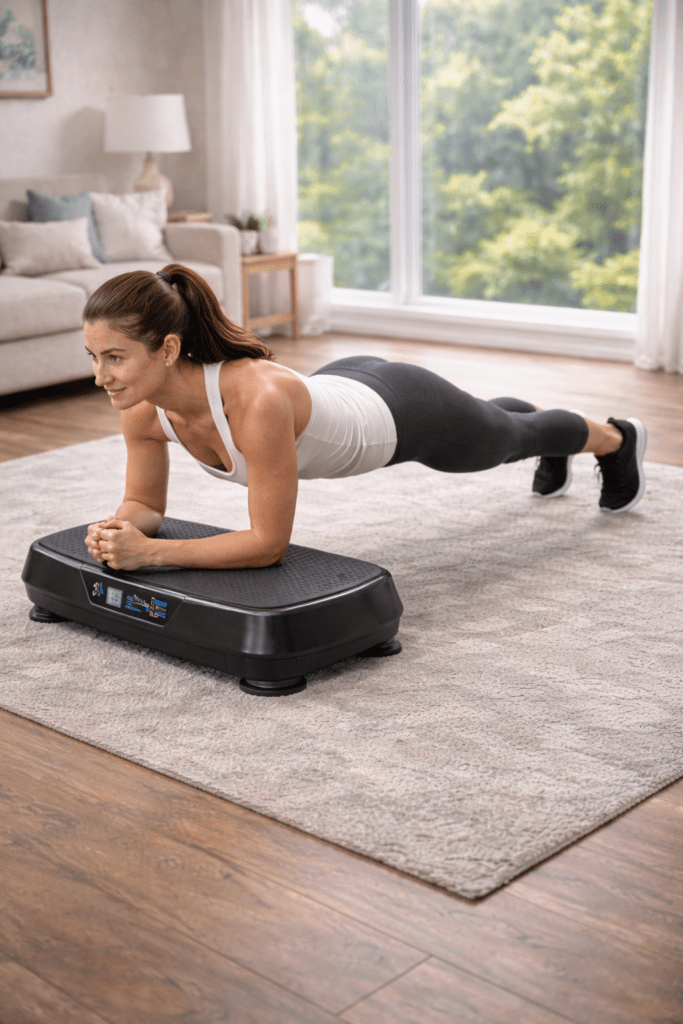
WBV is a tool.
It can:
- Stimulate muscles reflexively
- Improve balance
- Support circulation
It cannot:
- Cure disease
- Replace resistance training
- Override poor lifestyle habits
The trade-off is simple:
Low-impact stimulation vs lower total mechanical loading compared to heavy strength training.
If bone density is your goal, vibration alone is unlikely to be sufficient. In addition, if balance and mobility are your goal, it can be a useful component. In other words, know why you’re using it.
Biggest Safety Mistakes I See
- Locked knees (joint stress)
- Maximum frequency on day one
- Standing stiff and rigid
- Using it daily at high intensity
- Ignoring dizziness or discomfort
If you feel:
- Headache
- Joint pain
- Dizziness
- Numbness
Stop and reassess.
Start moderate. Progress gradually.
If you’re unsure about setup or intensity, review:
https://vibrationforhealth.com/how-to-use-a-vibration-plate/
https://vibrationforhealth.com/linear-vs-oscillating-vibration-plates/
Frequently Asked Questions
Is WBV dangerous?
For healthy adults using moderate settings and proper posture, it is generally low risk. But certain medical conditions require clearance.
Can older adults use vibration plates safely?
Yes, when supervised or properly programmed. Lower intensity and stability support are important.
Can WBV cause joint damage?
Improper use (locked knees, high intensity) may aggravate joints. Correct posture significantly reduces this risk.
Is it safe for osteoporosis?
Mild cases under physician guidance may benefit. Severe osteoporosis or recent fractures require medical clearance.
Should I use it every day?
Daily light sessions may be fine for healthy adults. High-intensity daily sessions are not recommended.
Reputable Resources for More Information
- Mayo Clinic – Whole-Body Vibration Overview
https://www.mayoclinic.org/healthy–lifestyle/fitness/expert-answers/whole-body-vibration/faq-20057958 - PubMed (NIH) – WBV Safety & Reviews
https://pubmed.ncbi.nlm.nih.gov/ - American Council on Exercise (ACE)
https://www.acefitness.org/ - National Institutes of Health (NIH)
https://www.nih.gov/
Conclusion
Whole-body vibration is not reckless. It’s also not universally appropriate.
For healthy adults using moderate settings, it can be a smart, low-impact addition. Plus, for medically complex individuals, clearance matters.
The safest approach is simple:
- Start low.
- Use proper posture.
- Increase gradually.
- Match the tool to the person.
That’s how you keep WBV beneficial — and responsible.