
I like vibration plates because they sit in a sweet spot: low-impact, time-efficient, and surprisingly “active” on your nervous system—even when you’re not moving much. But I also don’t like hype. Whole-body vibration (WBV) can be genuinely useful… and still not be a miracle machine.
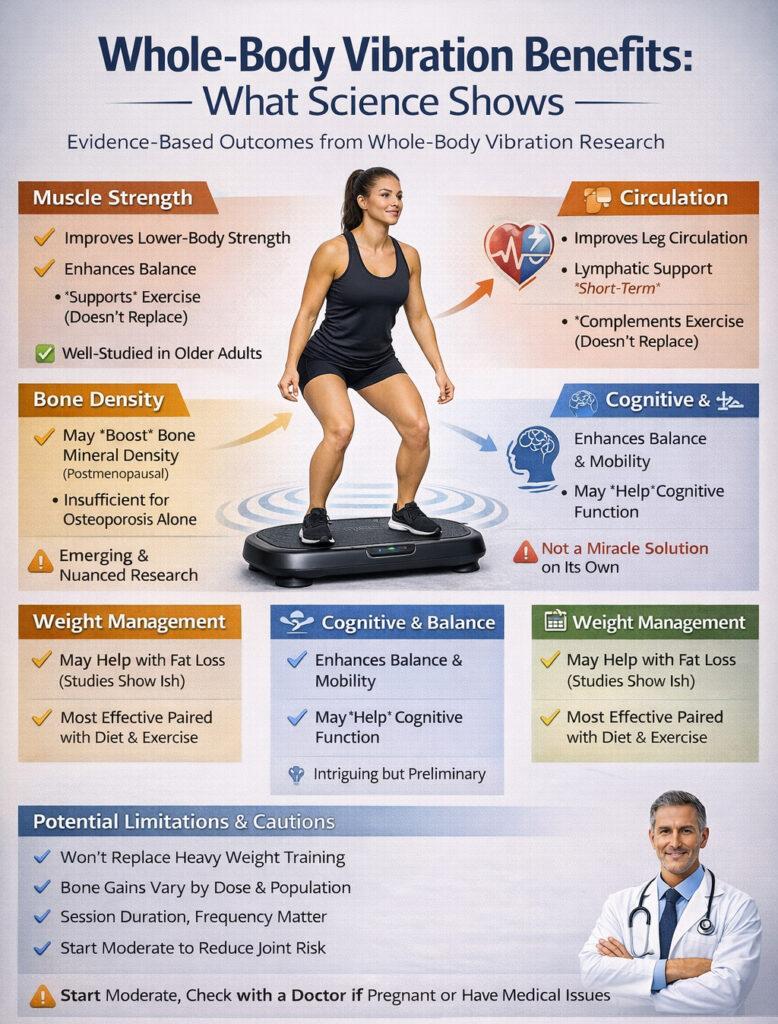
So this page is my “science-first” summary of what research suggests WBV can help with—and what it probably can’t, at least not on its own.
If you’re brand new and want the basics first, start here:
- https://vibrationforhealth.com/what-is-whole-body-vibration/
And if you want to make sure you’re using the plate safely (this matters a lot for outcomes), read: - https://vibrationforhealth.com/how-to-stand-properly-on-a-vibration-plate/
(Or if you prefer the broader how-to: https://vibrationforhealth.com/how-to-use-a-vibration-plate/)
1) Muscle Strength & Performance Improvements
Best-supported outcome: lower-body strength (especially in older adults and deconditioned populations).
Multiple systematic reviews and meta-analyses show WBV training can improve lower-limb strength and some measures of physical function—particularly when done consistently and with appropriate settings and positioning. A 2023 systematic review focusing on older adults concluded WBV was effective at improving lower-limb strength, while effects on power/endurance measures were less consistent.
A newer 2025 meta-analysis also found WBV produced significant improvements in various strength/power outcomes compared with non-exercise control groups (examples included knee extension, leg press, plantar flexion, and countermovement jump).
My practical take:
WBV is strongest as a “strength helper,” not a replacement for progressive resistance training. If you already lift, WBV can be a nice accessory (warm-up, finisher, balance + activation). If you don’t lift—or you’re rebuilding after inactivity—WBV can be an on-ramp.
Realistic expectation:
Think “meaningful improvement over 4–8 weeks” for leg strength and stability—not a dramatic transformation in days.
2) Bone Density & Musculoskeletal Health Effects
This is the area people get most excited about—and where the research is both promising and nuanced.
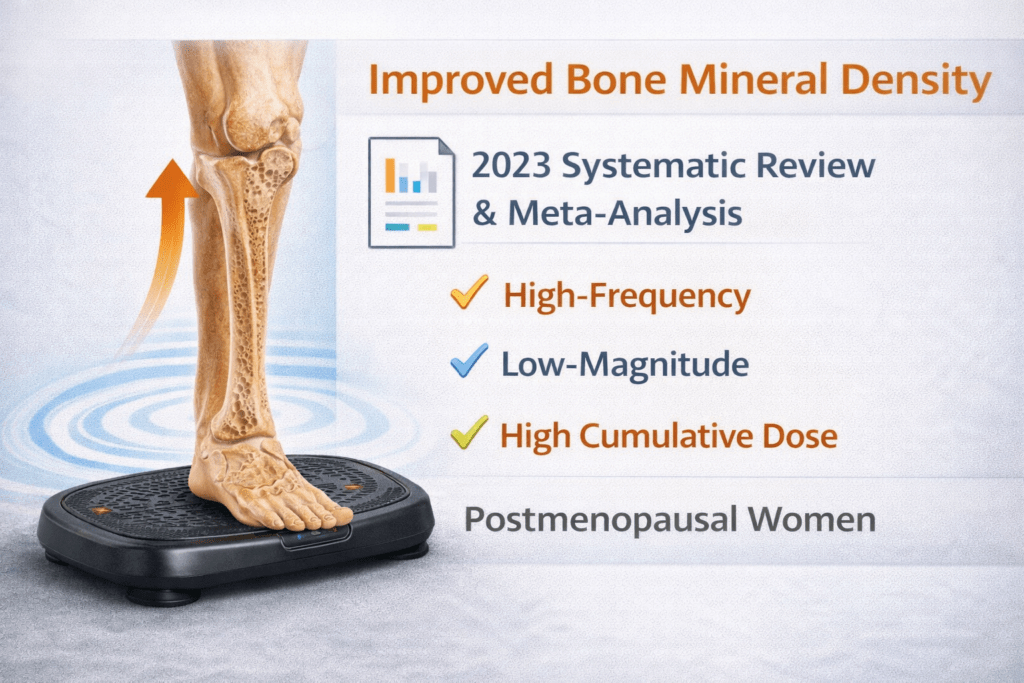
There are systematic reviews/meta-analyses suggesting WBV can produce small but statistically significant improvements in bone mineral density (BMD) in postmenopausal populations, depending on dose and protocol.
For example, a 2023 systematic review/meta-analysis reported significant effects on BMD in postmenopausal women and highlighted that high-frequency, low-magnitude, high cumulative dose protocols showed stronger evidence.
A 2024 meta-analysis in postmenopausal osteoporosis reported improvements in lumbar spine and femoral neck BMD, along with reductions in pain.
But it’s not universally positive across every study design and population. For instance, a 12-month randomized trial in postmenopausal women without osteoporosis reported no measurable effect on certain outcomes from daily WBV at tested frequencies.
Decision guidance:
- If bone density is your main goal, WBV is best viewed as a supportive tool alongside resistance training, impact-loading (as appropriate), vitamin D/calcium adequacy, and medical guidance when needed.
- The “dose” matters: frequency, amplitude, session duration, and total weeks all change outcomes.
Trade-off:
Higher intensity isn’t automatically better—especially if it compromises posture or irritates joints.
3) Research on Circulation & Lymphatic Effects
WBV can increase muscle contractions reflexively, and that can act like a mild “muscle pump,” which is one reason people often feel a circulation boost.
Research reviews suggest WBV—especially at relatively lower frequency/magnitude—can improve peripheral circulation parameters, and safety considerations may reference occupational vibration guidance like ISO standards while protocols are still being refined.
For the lymphatic side: people commonly claim “lymph drainage,” but the strongest evidence base is smaller and tends to be more indirect (circulation, muscle pump behavior). A cancer center educational article put it well: there may be short-term circulation effects, but it’s unlikely to replace full-body exercise for broad fitness outcomes—and expectations should be managed.
My honest framing:
If your legs/feet feel “heavy” from sitting all day, WBV can feel great. I treat it like a mobility + circulation snack. But if someone is trying to use WBV as their primary strategy for swelling/lymph issues, I’m cautious: that’s a “talk to your clinician” lane.
4) Cognitive, Balance, and Mobility Insights (Emerging Research)
Balance and mobility are two of the most practical benefits people notice—especially older adults.
A classic systematic review looked at WBV effects on balance, mobility, and falls in older adults (search up to 2011). More recent meta-analyses continue to report improvements in strength, balance, mobility, gait, and physical performance in very old populations (including nursing-home residents).
Cognition is more “emerging.” A 2024 review discussing WBV and brain/immune pathways notes mixed findings across systematic reviews: some studies show cognitive improvements, others do not, and more standardization is needed.
Translation into real life:
If your goal is staying steady on your feet, moving better, or rebuilding confidence after being sedentary, WBV can be a solid add-on—especially when combined with simple movements (mini squats, calf raises, split stance holds).
5) Weight Management Science (With Caveats)
WBV is not a fat-loss shortcut—but it may help as an adjunct.
A 2021 systematic review/meta-analysis found WBV had a positive effect on reducing fat mass, especially when combined with diet and exercise. Another 2021 meta-analysis on obesity/metabolic risk found decreases in body fat and some cardiovascular markers, but noted changes may not be clinically large on their own.
What I tell people bluntly:
WBV can support a weight-loss plan by improving movement tolerance, strength, and consistency. But if you want weight change, you still need the boring pillars: nutrition, steps, strength training, sleep.
Risks, Who Should Be Careful, and Realistic “Do This, Not That”
General risks/trade-offs:
- Too much intensity too soon → headaches, joint irritation, low-back discomfort
- Locked knees → vibration goes into joints/spine (bad trade)
- “Chasing max Hz” → not how WBV dosing works
Use extra caution (get medical clearance) if you have:
- Pacemaker/implanted devices
- Recent fractures, severe osteoporosis, or acute joint injuries
- Uncontrolled cardiovascular conditions
- Pregnancy
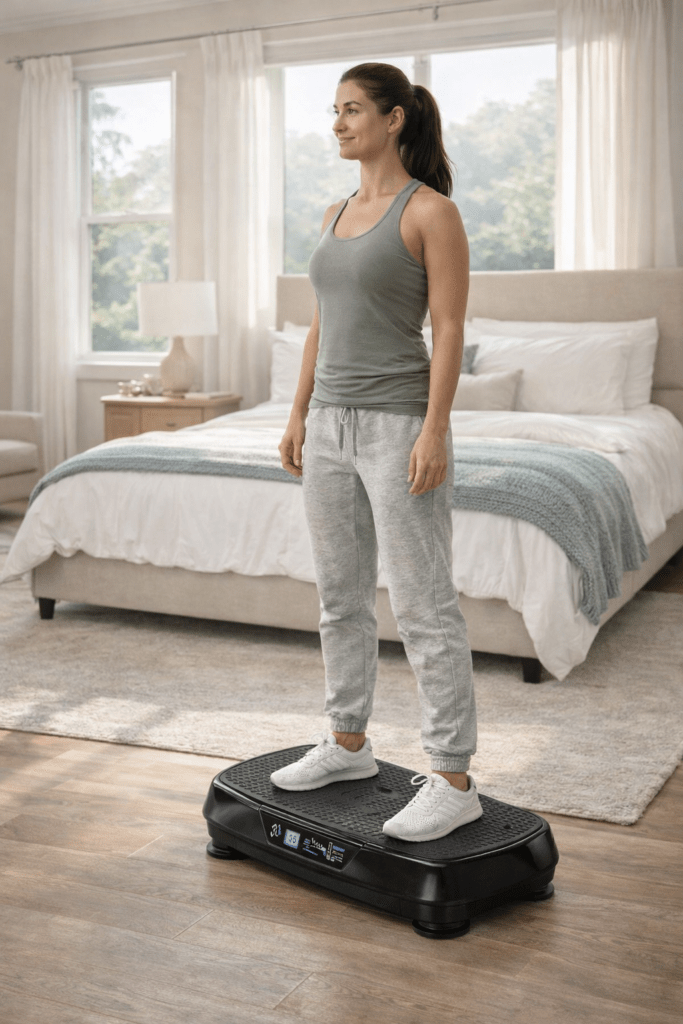
If you’re unsure you’re using the plate correctly, posture is the first fix:
And if you’re still shopping, plate type matters for feel and load:
- https://vibrationforhealth.com/linear-vs-oscillating-vibration-plates/
- https://vibrationforhealth.com/vibration-plate-types/
Frequently Asked Questions
Is WBV “proven” to work?
For lower-body strength and some physical function outcomes, evidence is reasonably supportive, especially in older adults. For other areas (like cognition), evidence is still emerging and mixed.
How long until I notice benefits?
Many people feel circulation and muscle “wake up” immediately, but meaningful changes in strength/balance typically show up over 4–8 weeks with consistent use.
Can WBV replace weight training?
No. It can complement it—but resistance training remains the gold standard for strength and bone loading.
Is WBV safe?
Often yes for healthy adults, but dosing and posture matter. If you have medical conditions or implants, get clinician guidance first.
What’s the biggest mistake people make?
Locked knees and overly high intensity. Fix posture first, then adjust settings.
Reputable Resources for More Information
- Mayo Clinic – Whole-body vibration overview and balanced caveats
- PubMed (NIH) – Search database for WBV systematic reviews and trials
- Systematic review/meta-analysis (BMD, postmenopausal women)
- Systematic review/meta-analysis (fat mass outcomes)
Conclusion on Whole Body Vibration Research:
WBV is one of those tools that shines when you use it for the right reasons:
- Strongest evidence: lower-body strength + functional mobility support
- Promising but mixed: bone density outcomes depending on population/protocol
- Useful “feel it fast”: circulation and movement readiness
- Emerging: cognition and brain-related outcomes
- Weight loss: possible as an add-on, not a standalone solution
If you keep expectations realistic—and you prioritize posture, consistency, and smart dosing—WBV can absolutely earn a spot in a modern, evidence-based routine.