
If you’ve started shopping for a vibration plate, you’ve probably noticed something: Every brand claims theirs is the “most powerful,” “highest frequency,” or “clinically proven.” That’s marketing.
What actually matters is whether the machine fits your goals, body, and budget.
I’ve seen people overspend on features they don’t need—and others buy the cheapest unit possible, only to outgrow it in six months.
This guide will help you choose smart the first time.
If you’re new to vibration entirely, I recommend starting here first:
https://www.vibrationforhealth.com/whole-body-vibration-explained/
And if you’re unsure about plate types, this comparison is essential:
https://www.vibrationforhealth.com/vertical-vs-oscillating-vibration-plate/
Now let’s break it down step by step.
Step 1: Know Your Goal Before You Shop
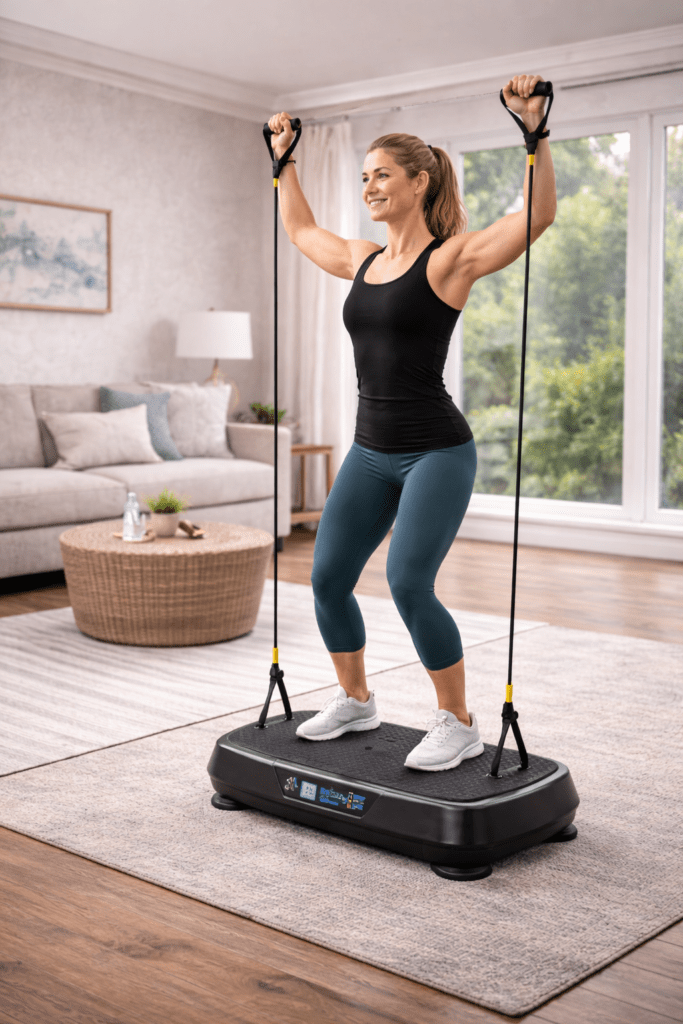
The biggest mistake? Buying based on specs instead of purpose.
Ask yourself:
- Are you focused on balance & mobility?
- Trying to support muscle strength?
- Interested in bone density protocols?
- Looking for a low-impact recovery tool?
Different goals favor different frequency ranges and plate styles.
If you don’t know your target frequency ranges yet, read:
https://www.vibrationforhealth.com/best-vibration-plate-frequency/
Buying without goal clarity leads to feature overload.
Buying Checklist (What Actually Matters)
Here’s the framework I personally use.
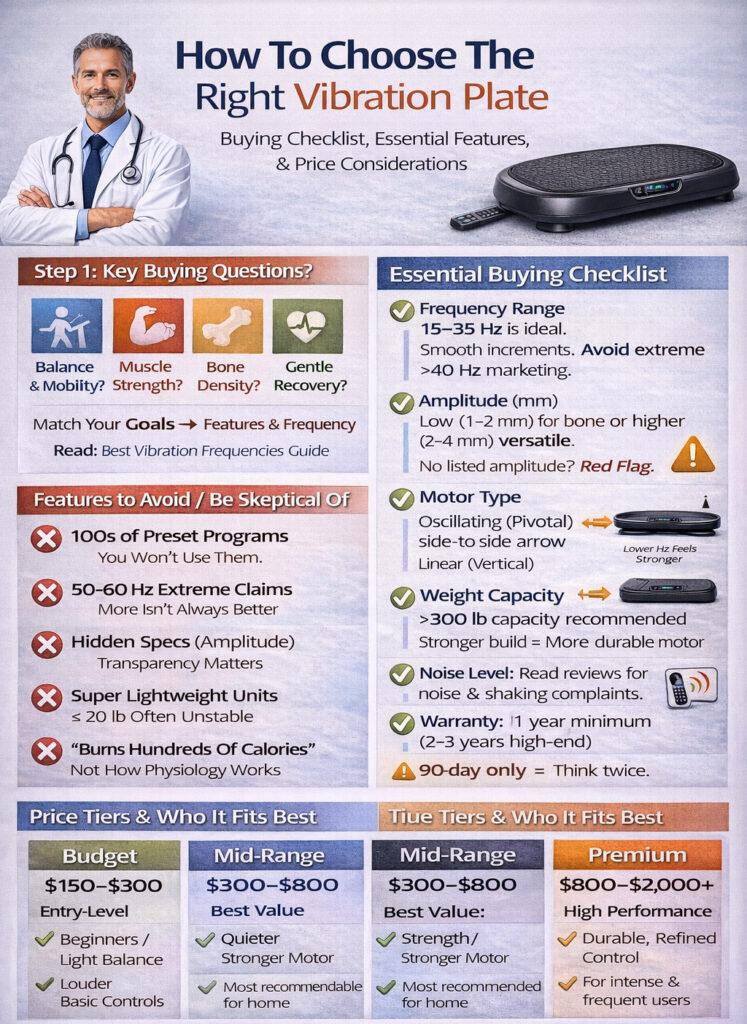
✅ 1. Frequency Range
Look for:
- At least 15–35 Hz range
- Smooth increments (1 Hz steps preferred)
Why?
Lower frequencies (15–25 Hz) are great for beginners and balance work.
Moderate-to-higher (25–35 Hz) supports strength activation.
Machines advertising 50+ Hz often use it as a marketing hook. You rarely need that range.
✅ 2. Amplitude (Movement Distance)
Manufacturers may not clearly list amplitude, but it matters.
- Low amplitude (1–2 mm): gentler, often used for bone protocols
- Moderate amplitude (2–4 mm): more versatile for strength
If amplitude isn’t listed anywhere? That’s a red flag.
✅ 3. Motor Type
There are two primary types:
Oscillating (Pivotal)
- Side-to-side movement
- Often feels more intense at lower Hz
- Popular for balance and mobility
Linear (Vertical)
- Up-and-down movement
- Often preferred for athletic-style use
Your experience will vary significantly based on motor type. If possible, test one in person before buying.
✅ 4. Weight Capacity & Build Quality
Look for:
- 300+ lb weight capacity (even if you weigh less)
- Solid base construction
- Minimal flex in platform
A machine operating near its maximum capacity wears down faster. Higher weight rating = more durable motor in many cases.
✅ 5. Noise Level
Some plates are whisper quiet. On the other hand, others sound like a washing machine off balance. So, if you live in an apartment or plan to use it early mornings:
Therefore, check reviews specifically for:
- “quiet”
- “vibration noise”
- “floor shaking”
Plus, cheap units often lack sound dampening. Also see: How Loud are vibration plates?
✅ 6. Warranty
This is huge.
Look for:
- At least 1-year warranty minimum
- 2–3 years on higher-end models
- Clear return policy
If a company only offers 90 days, that’s not confidence.
Features to Avoid (Or Be Skeptical Of)
Let’s cut through fluff.
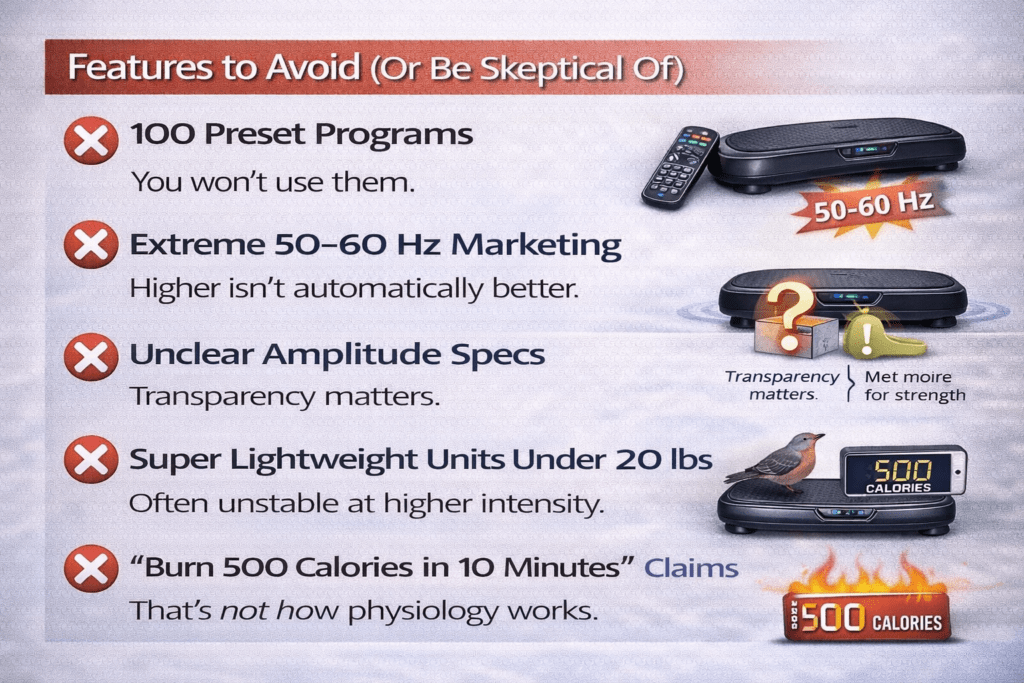
- 100 preset programs – you won’t use them.
- Extreme 50–60 Hz marketing: higher isn’t automatically better.
- Unclear amplitude specs (transparency matters).
- Super lightweight units under 20 lbs – often unstable at higher intensity.
- “Burn 500 calories in 10 minutes” claims – that’s not how physiology works.
You’re buying a motor and platform. Not a miracle.
Price Tiers & Who They’re Best For
Here’s the honest breakdown.
💲 Budget Tier ($150–$300)
Best for:
- Beginners
- Light balance use
- Occasional sessions
Trade-offs:
- Louder
- Lower durability
- Limited fine control
Good entry point if you’re testing whether WBV fits your routine.
💲💲 Mid-Range ($300–$800)
Best for:
- Consistent home use
- Strength & mobility goals
- Better frequency control
Typically:
- Quieter
- Better warranty
- More stable
This is the sweet spot for most people.
💲💲💲 Premium ($800–$2,000+)
Best for:
- High-frequency users
- Athletes
- Rehabilitation settings
You’re paying for:
- Motor durability
- Precision control
- Stability
- Often commercial-grade build
Unless you’re using it frequently, this may be overkill.
Trade-Offs You Should Understand
Higher-end models:
- Cost more
- Last longer
- Are quieter
- Offer smoother vibration
Lower-end models:
- Affordable
- Great for beginners
- May wear out faster
- Less refined control
There’s no “perfect” plate.
There’s the plate that fits your current phase.
Realistic Expectations
Even the best machine:
- Won’t replace strength training
- Doesn’t magically fix posture
- Can’t melt fat passively
The plate is a tool.
Results come from:
- Proper posture
- Consistency
- Goal-specific programming
If you haven’t mastered safe usage yet, start here:
https://www.vibrationforhealth.com/how-to-use-vibration-plate/
Frequently Asked Questions
Do I need 40+ Hz capability?
No, most benefits occur within 15–35 Hz for general users.
Is oscillating better than linear?
It depends on your goal and comfort preference. Oscillating often feels more intense at lower settings.
Are cheap vibration plates dangerous?
Not necessarily—but build quality, stability, and warranty matter.
Should beginners buy high-end?
Not usually – start mid-range unless you know you’ll use it long-term.
Does weight capacity matter if I’m under the limit?
Yes, higher capacity usually means a more durable motor.
Reputable Resources for More Information
- Mayo Clinic – Whole-Body Vibration Overview
https://www.mayoclinic.org/healthy-lifestyle/fitness/expert-answers/whole-body-vibration/faq-20057958 - PubMed (NIH) – Research Database
https://pubmed.ncbi.nlm.nih.gov/ - American Council on Exercise (ACE)
https://www.acefitness.org/ - National Institutes of Health (NIH)
https://www.nih.gov/
Conclusion
Choosing a vibration plate isn’t about chasing the highest number, it’s about:
- Matching frequency range to your goals
- Choosing the right motor type
- Prioritizing durability and warranty
- Ignoring flashy marketing
Start clear, buy smart and use it consistently. That’s how you turn a vibration plate from a novelty into a real training tool.